
The CMS ACCESS Model launched July 5, 2026, with two live clinical tracks and a third launching soon: Early CKM, Advanced CKM, and Behavioral Health. Each delivers technology-enabled chronic care to Original Medicare beneficiaries through distinct payment structures and outcome requirements. For healthcare executives, compliance teams, and IT leaders evaluating participation, understanding the differences between these tracks is the first practical decision the program requires.
What Is the CMS ACCESS Model?
CMS ACCESS, Advancing Chronic Care with
Effective, Scalable Solutions, is a 10-year voluntary CMMI program that pays
participating organizations recurring per-beneficiary payments tied to whether
patients achieve measurable health outcomes, not whether services were
rendered.
The payment structure, between $15 and
$35 per patient per month and declining after Year 1, makes manual care
delivery financially unsustainable at scale. CMS designed the economics to
require automated, AI-enabled care. Technology is not a differentiator in this
model. It is a prerequisite.
The model applies only to Original
Medicare fee-for-service beneficiaries. Organizations serving Medicare
Advantage populations exclusively are not eligible.
Innovaccer, operating through Story
Health Partners, is an accepted ACCESS participant across the Early CKM and
Advanced CKM tracks.
##
Early CKM,
Advanced CKM, and Behavioral Health: Comparing the Tracks
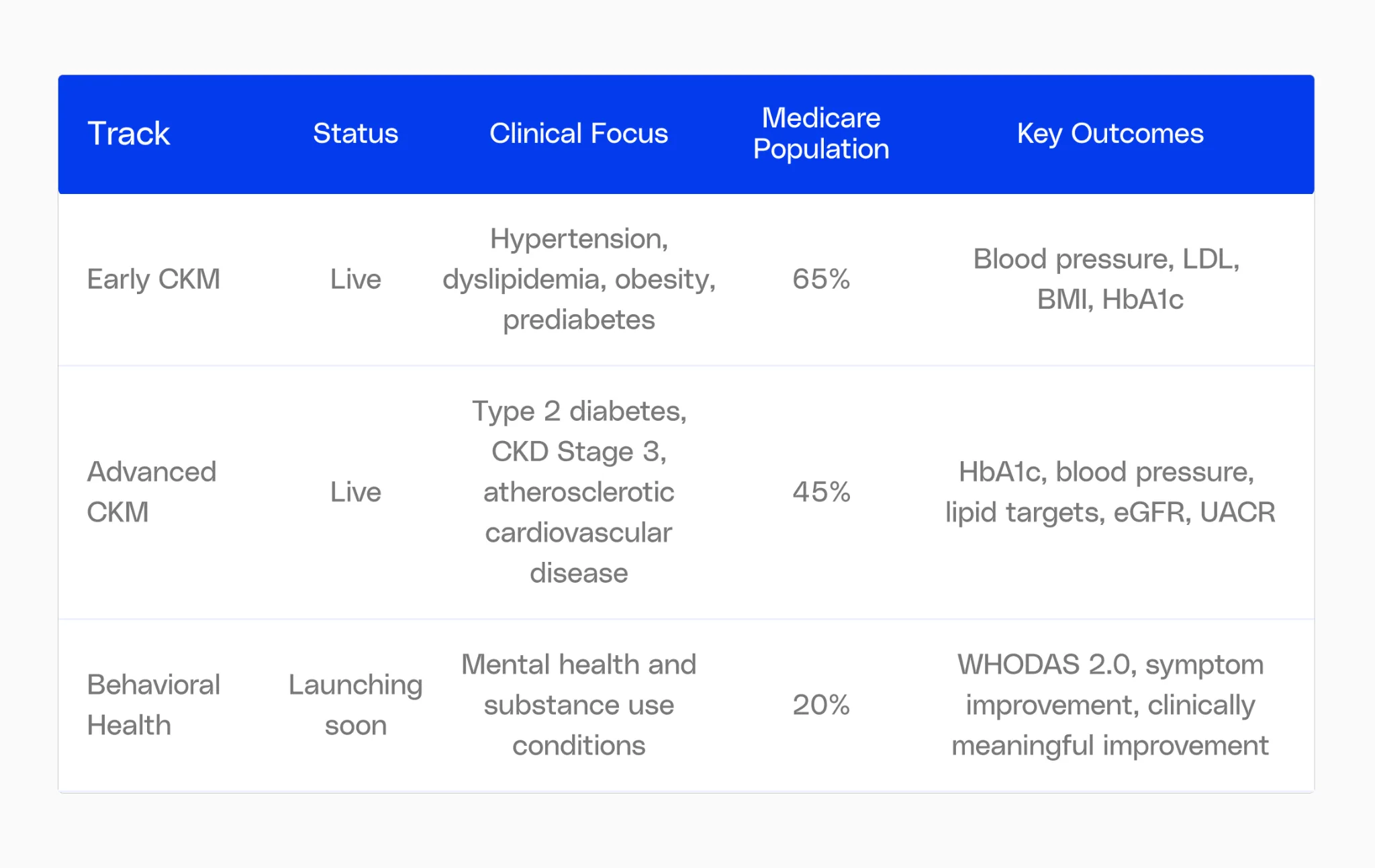
Early CKM targets patients with cardiometabolic risk factors: hypertension, dyslipidemia, obesity, and prediabetes. It focuses on upstream intervention before risk factors progress to established chronic disease. Key outcomes measured include blood pressure control, LDL improvement, BMI reduction, and HbA1c. Early CKM covers approximately 65% of the Medicare population, making it the broadest entry point for organizations new to ACCESS.
Advanced CKM addresses patients with established chronic conditions: type 2 diabetes, CKD Stage 3, and atherosclerotic cardiovascular disease. It requires more intensive monitoring and care coordination infrastructure. Key outcomes include HbA1c, blood pressure, lipid targets, and kidney markers including eGFR and UACR. Advanced CKM covers approximately 45% of the Medicare population.
Behavioral Health focuses on Medicare beneficiaries with mental health and substance use conditions, recognizing that these populations experience fragmented care and poor outcomes under traditional payment models. The track emphasizes technology-enabled interventions including telehealth and digital therapeutics. Key outcomes measured include functional improvement (WHODAS 2.0), symptom improvement, and the share of patients with clinically meaningful improvement. Behavioral Health covers approximately 20% of the Medicare population and is launching soon, not yet live as of July 5.
Organizations can participate in multiple tracks simultaneously if they serve diverse patient populations and maintain the infrastructure each track requires. Track selection should align with existing clinical strengths, not aspirational ones. CMS measures outcomes against defined thresholds for 10 years. Organizations that cannot meet performance expectations carry that risk for the duration.
Eligibility and Application Timelines
Organizations must be enrolled in Medicare Part B as a provider or supplier. Eligible types include physician groups, ACOs, health systems, and digital health companies with the clinical and technology capabilities required for their selected tracks.
The first cohort launched July 5, 2026; applications for it were accepted through April 1, 2026. CMS accepts applications for later cohorts on a rolling basis through 2033. Later cohorts carry no penalty, but each week of delay is a smaller eligible population as enrolled participants conduct active patient outreach. The do-nothing alternative has a compounding cost most organizations have not fully modeled.
Technology Requirements by Track
Manual data entry does not meet CMS compliance requirements for any track.
FHIR-based interoperability is mandatory. Organizations must exchange patient data with CMS systems, referring providers, and care team members using FHIR R4 standards. Organizations relying on legacy systems face significant barriers to compliant participation.
EHR integration is essential across all tracks. ACCESS participants must capture and report clinical data through systems capable of generating the quality metrics CMS uses to evaluate performance.
Remote monitoring requirements differ by track. Early CKM requires blood pressure and weight monitoring at minimum. Advanced CKM requires more intensive kidney function monitoring alongside cardiometabolic indicators. Behavioral Health track technology requirements center on telehealth platforms and digital therapeutic tools suited to mental health and substance use populations. All tracks require real-time action on monitoring data, not retrospective batch processing.
Innovaccer delivers FHIR-integrated CMS submissions as part of its standard operating model for the Early CKM and Advanced CKM tracks, with automated care plan updates and outcome reporting rather than manual submission workflows. It is the same principle behind an Autonomous Operations Platform for Healthcare: infrastructure that keeps running without someone watching every step.
Frequently Asked Questions
What is the difference between Early CKM, Advanced CKM, and Behavioral Health?
How much does CMS ACCESS pay?
Who is eligible?
What is the next application deadline?
What technology is required?
What to Do Now
The first cohort is live. Enrollment is open. Patients are attesting to participants today.
Assess which track matches your existing clinical capabilities. Conduct a technology readiness assessment against FHIR, EHR integration, and monitoring requirements. Evaluate participant partnerships if building ACCESS infrastructure internally is not feasible.
Innovaccer absorbs all outcome risk
through Story Health Partners across the Early CKM and Advanced CKM tracks,
delivers bidirectional PCP communication and a shared clinical record, and
keeps every referred patient inside your network. Organizations that engage now
build revenue, infrastructure, and patient relationships that compound over 10
years. Those that wait spend the next decade working around a program that
launched without them.
To learn more, visit innovaccer.com/cms-access.