
For years, prior authorization (PA) has been one of the most scrutinized functions within healthcare. Providers have long cited delays, administrative burden, and inconsistent decision-making as barriers to timely patient care. Regulators have responded with stronger transparency requirements, and health plans are now entering a new era where their utilization management (UM) performance will be visible to providers, regulators, employers, and members alike.
The CMS Interoperability and Prior Authorization Final Rule (CMS-0057-F) marks a significant shift in how Medicare Advantage, Medicaid, CHIP, and Qualified Health Plan issuers manage and report prior authorization. While much attention has focused on faster decision timelines and API requirements, another equally important mandate is often overlooked: the public reporting of prior authorization performance metrics.
Beginning with CMS-0057 compliance, health plans must publicly disclose key prior authorization metrics that reveal how efficiently and consistently they process authorization requests. These reports will create unprecedented transparency around utilization management operations and establish new benchmarks for operational excellence.
The question is no longer whether health plans are processing authorizations efficiently. The question is whether they can prove it.
What CMS-0057 requires health plans to report
Under CMS-0057, impacted health plans are required to publicly publish annual prior authorization metrics through their websites. These disclosures are designed to improve accountability while giving providers greater visibility into payer performance.
The reported metrics include:
- Total number of prior authorization requests received
- Number and percentage of approved requests
- Number and percentage of denied requests
- Number and percentage of requests approved after appeal
- Average and median decision turnaround times
- Decisions completed within CMS-required timeframes
- Additional operational statistics demonstrating compliance with regulatory requirements
Although these metrics may appear straightforward, they collectively paint a detailed picture of how effectively a health plan's utilization management organization operates.
For providers evaluating payer relationships, these numbers become indicators of responsiveness, consistency, and administrative burden. For regulators, they demonstrate compliance. For health plans, they become a reflection of operational maturity.
What the numbers really reveal
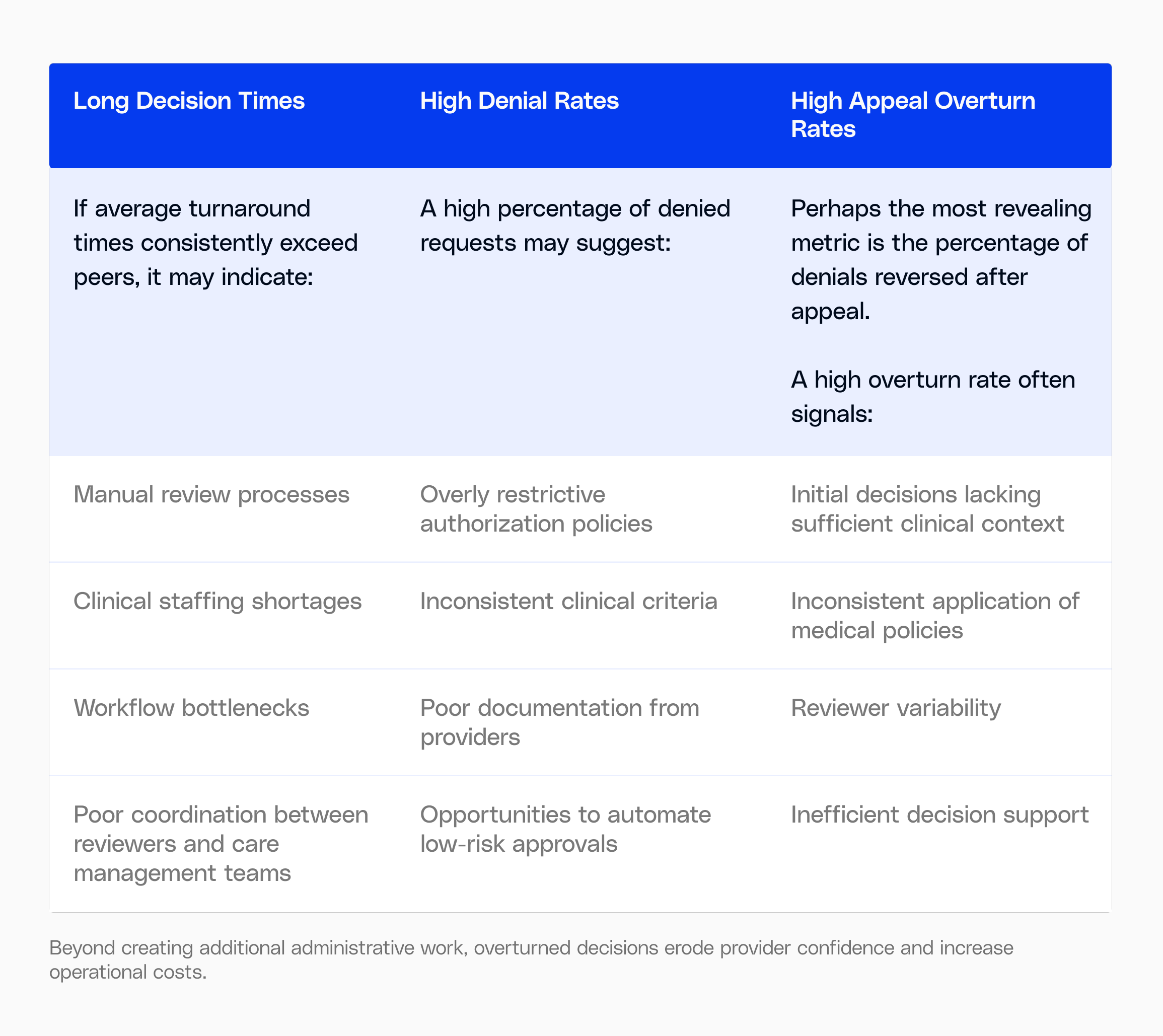
Public reporting goes beyond compliance. It exposes the health of an organization's utilization management operations.
For example:
Benchmarking: moving beyond compliance
Public reporting also creates an opportunity for comparative benchmarking.
Health plans will increasingly ask:
- How do our approval rates compare with similar organizations?
- Are our turnaround times competitive?
- Are providers experiencing more friction with our authorization process than with other payers?
- Which service lines generate the highest denial or appeal rates?
- Where should we prioritize operational improvements?
Benchmarking allows UM leaders to move from reactive compliance reporting toward proactive performance management.
Organizations that continuously monitor these indicators can identify process gaps early, improve clinical consistency, and reduce unnecessary administrative costs before performance becomes a regulatory concern.
Modern utilization management improves outcomes for members and providers
Utilization management is often discussed in terms of operational efficiency and provider experience, but its most important impact is on members. When prior authorization processes are slow, inconsistent, or opaque, members experience delays in care, confusion about coverage decisions, and interruptions in treatment. When UM processes are streamlined and transparent, members benefit from faster access to medically necessary services and a more connected care journey.
At the same time, providers experience less administrative friction, fewer unnecessary appeals, and greater confidence in payer decisions. In this way, modern utilization management becomes a shared value driver, strengthening collaboration between health plans and providers while keeping the member at the center of every decision.
Historically, utilization management has been viewed primarily as an internal cost-control function.
CMS-0057 changes that dynamic.
Public performance data will influence how providers perceive health plans. Slow decisions, inconsistent approvals, or high appeal overturn rates can increase provider frustration and damage collaboration.
Provider abrasion often manifests as:
- Increased phone calls and status inquiries
- More appeals and reconsideration requests
- Administrative burden for provider staff
- Lower provider satisfaction
- Delays in patient care
Conversely, organizations that consistently deliver fast, predictable, and transparent authorization decisions foster stronger provider relationships, reduce administrative friction, and improve overall care coordination.
As value-based care continues to evolve, provider experience is becoming an important measure of operational excellence, not just a customer service metric.
What "good" looks like
High-performing utilization management organizations share several common characteristics.
They are able to:
- Consistently meet CMS turnaround requirements
- Automate routine authorization workflows while reserving clinician review for complex cases
- Apply standardized clinical criteria across all reviewers
- Maintain complete audit trails for every decision
- Monitor operational performance continuously rather than only during compliance reporting cycles
- Identify bottlenecks before they impact providers
- Produce accurate regulatory reports without relying on manual data collection
Rather than viewing CMS-0057 as another reporting obligation, leading organizations treat transparency as a catalyst for operational improvement.
The result is faster decisions, better provider experiences, improved compliance, and greater organizational confidence.
Preparing for the autonomous future of utilization management
CMS-0057 is more than a new reporting requirement. It signals the beginning of a new era in utilization management. As public reporting increases transparency around prior authorization performance, health plans must move beyond manual processes and traditional workflow automation toward intelligent, autonomous operations.
Legacy UM models rely on fragmented systems, manual reviews, disconnected data, and reactive reporting. These approaches make it difficult to consistently meet regulatory timelines, scale operations efficiently, or deliver a seamless provider experience.
The next generation of utilization management will be powered by autonomous AI systems that can intelligently ingest clinical information, understand medical context, orchestrate workflows, assist reviewers with evidence-based recommendations, continuously monitor performance, and proactively identify operational bottlenecks before they impact compliance or member care.
Health plans that embrace autonomous UM won't just be better positioned for CMS-0057. Prior authorization becomes faster, more transparent, and more consistent, improving provider satisfaction while reducing administrative burden.
How Galaxy UM powers autonomous utilization management
Galaxy Utilization Management combines AI, automation, and real-time operational intelligence to help health plans build an autonomous UM function that is compliant, efficient, and continuously improving.
With Galaxy UM, health plans can:
- Automate intake and processing of prior authorization requests from faxes, portals, APIs, and electronic transactions.
- Apply AI to summarize clinical documentation, identify missing information, and assist reviewers with evidence-based recommendations.
- Continuously monitor turnaround times and SLA performance across every authorization request.
- Maintain complete audit trails from intake to decision for every case to simplify compliance and regulatory reporting.
- Provide real-time operational dashboards with actionable insights into authorization volumes, approval patterns, denial trends, and performance metrics.
- Identify workflow bottlenecks and operational inefficiencies proactively using AI-driven intelligence.
- Orchestrate work across clinical reviewers, care management, provider operations, and downstream systems to reduce manual handoffs and accelerate decision-making.
Rather than simply digitizing existing workflows, Galaxy UM enables health plans to evolve toward autonomous utilization management, where AI augments clinical teams, streamlines operations, strengthens regulatory readiness, and delivers faster, more consistent prior authorization decisions for providers and members.