The case for change
Across healthcare, highly trained professionals spend too much time on manual administrative work: prior authorizations, claims reviews, documentation, compliance, and safety processing.
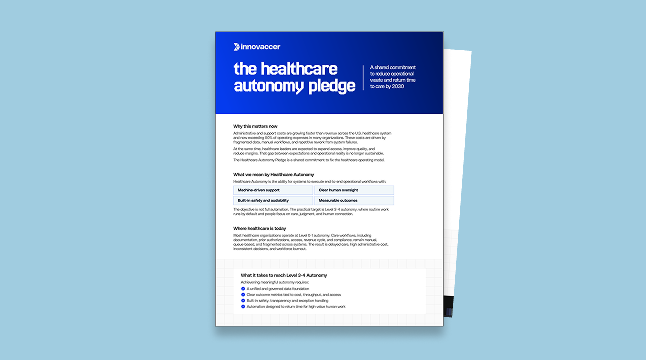
Administrative and support costs are rising faster than revenue across the U.S. healthcare system and now exceed 50% of operating expenses in many organizations. These costs are driven by fragmented data, manual workflows, and repetitive rework from system failures.
At the same time, healthcare leaders are expected to expand access, improve quality, and protect margins. The gap between expectations and operational reality is no longer sustainable.
This is not a performance problem. It is an infrastructure problem.
And today, we have the technology, data, and AI foundation to change it.
The Healthcare Autonomy Pledge is a shared commitment to fix the healthcare operating model by removing avoidable operational waste and returning time and capacity to care.
What we mean by Healthcare Autonomy
Healthcare Autonomy is the ability for systems to execute end-to-end operational workflows with:

Machine-driven support

Clear human oversight

Built-in safety and auditability

Measurable outcomes

Autonomy does not replace expertise. It elevates it.Machines should handle routine, structured tasks. Humans should focus on judgment, care, and innovation.
The objective is not full automation. The practical target is Level 3 to Level 4 autonomy, where routine work runs by default, exceptions are routed cleanly, and people focus on high-value decisions and human connection.
Where healthcare is today
Most healthcare organizations operate at Level 0 to Level 1 autonomy. Core workflows, including documentation, prior authorization, access, revenue cycle, and compliance, remain manual, queue-based, and fragmented across systems.
The result is delayed care, high administrative cost, inconsistent decisions, and workforce burnout.
What it takes to reach Level 3 to Level 4 autonomy

A unified and governed data foundation
Clear outcome metrics tied to cost, throughput, and access
Built-in safety, transparency, and exception handling
Automation designed to return time for high-value human work
The Pledge
We pledge to unite as healthcare leaders to build a modern healthcare operating system, where routine work is handled safely so humans can focus on judgment, care, and innovation.
We believe care should move at the speed patients need, not the speed paperwork allows.
By signing this pledge, as participating organizations
we commit to:
Systematically reducing administrative waste
Identify high-friction workflows and remove manual, repetitive work that technology can safely handle.
Advancing Level 3 to Level 4 operational autonomy
Move beyond pilots to scaled autonomy, where machines manage routine structure, logic, retrieval, and documentation, while humans focus on judgment and complexity.
Building on clean, connected data infrastructure
Strengthen the interoperability and governance required to make autonomous operations possible.
Measuring outcomes, not activity
Success will not be defined by tools deployed or models launched. It will be defined by:
- time returned to clinicians and reviewers
- denials prevented
- claims processed correctly the first time
- cycle times shortened
- operational costs controlled
Protecting human expertise
Design systems that elevate professionals by reducing burnout, improving decision quality, and increasing leverage so experts can focus on high-value work.
Ensuring transparency and accountability
Track savings and operational improvements, share progress, and continuously refine systems based on measurable results.
Improving healthcare for patients
Reducing administrative friction across providers, payers, and life sciences enables faster treatment access, improved coordination, more efficient trials, and better outcomes.
Practical commitment (12 to 24 months)
Establish an autonomy roadmap with measurable impact, including outcome-based targets for cost reduction, cycle time, and access, backed by cross-functional governance for safety and accountability.
Health systems who’ve joined