Last year, when Saudi Arabia announced the “Project Transcendence”, a staggering $100 billion initiative to build a robust AI ecosystem in the nation, it sent a clear message: countries in the Middle East are no longer just exploring technologies but looking to lead in building and shaping them globally.
Fast forward nearly a year, and that ambition is beginning to take shape across the region, especially in healthcare. In hospitals and clinics, we’re seeing AI agents being used to ease administrative burden, improve patient communication, and support care teams with real-time information. Whether it’s AI agents spotting early signs of cancer or a contact center bot answering appointment queries, the technology is here and advancing faster than ever.
But here’s the real question: Can AI agents move beyond the hype? That’s unarguably the most important question that healthcare leaders must now confront. Because while several countries in the region have a solid vision in place on leveraging AI to drive their healthcare goals, there’s only so much fancy technology can achieve.
AI in Middle Eastern Healthcare: What’s Working Today
Let’s look at some examples across the region where AI is already making significant strides:

Why AI Agents Haven’t Achieved Full-Scale Impact in the Middle East (Yet)
While the region has made encouraging progress in deploying AI agents, several challenges keep these solutions from scaling across entire health systems:
- Data still exists in silos: If we want AI agents, or for that matter, any technological solution to improve healthcare outcomes, we need to solve the problem of data silos. Most healthcare organizations in the region still operate fragmented systems with crucial information( lab results, imaging data) residing in isolated platforms that can’t communicate with each other. Without streamlined flow of data, AI tools will remain underutilized and underpowered.

- Most solutions aren’t always regionally relevant: Most AI models aren’t always trained on data that reflects the diversity of patients and diseases in the Middle East. This can lead to biased outputs and inaccurate predictions. For example, an AI model predicting the risk of diabetes may underperform if it hasn’t been trained on dietary patterns prevalent in the region.
- Data Governance and management still have gaps: While access to healthcare data is expanding, clear frameworks for using that data responsibly are still evolving. Some key questions like who owns the data, how consent is managed, and who’s responsible when AI gets it wrong remain mostly open and need to be clearly defined. With a lack of stronger, more harmonized policy across the region, trust in AI will be difficult to expand.
- The human element is often overlooked: Technology alone isn’t enough to drive change. AI agents will only deploy (effectively) when clinicians and staff are trained and empowered to incorporate them seamlessly into their workflows.
What Will it Take to Truly Operationalize AI Agents in Healthcare?
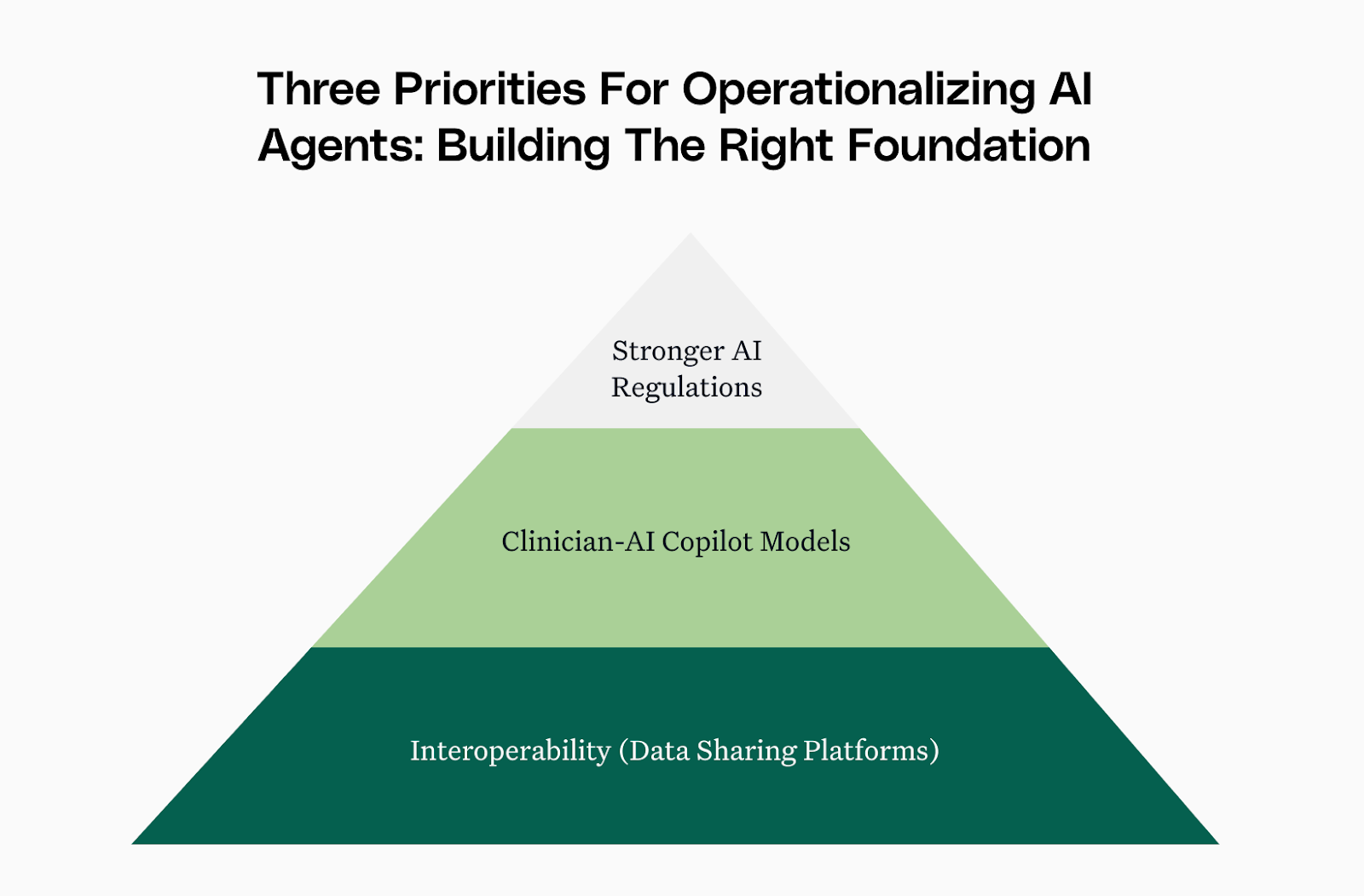
For AI agents to create an impact on Middle East healthcare, bold shifts are needed, not only in technology, but also in infrastructure, policy, and culture.
Interoperability must become non-negotiable
AI agents need connected and timely data to support providers in improving health outcomes. That means government and healthcare providers must collaborate on building unified health data platforms. Dubai’s NABIDH (Network & Analysis Backbone for Integrated Dubai Health) is a step in that direction. Having consolidated over 9 million patient records across public and private providers, NABIDH enables AI systems to access longitudinal patient histories, flag risks earlier, and personalize care more effectively.
Similarly, Abu Dhabi’s Malaffi has laid important groundwork as the region’s first Health Information Exchange platform. By enabling the secure exchange of patient information across care settings, it has played an instrumental role in improving care coordination in the region.
Other countries such as Bahrain are making progress through their National Health Information Systems (Hekma), which unify medical and financial data, from EMRs to insurance claims and pharmaceutical systems, laying the groundwork for AI-ready data exchange. Similarly, Qatar’s national eHealth strategy focuses on creating a connected, person-centered system. Its rollout of the Clinical Information System (CIS) across public hospitals and primary care centers has enabled real-time data access, better care coordination, and the foundation for AI-driven decision-making.
Along the same lines, Oman’s Al‑Shifa system, which serves as the backbone of its national health information infrastructure, connects over 200 facilities through unified EMRs, lab data, and pharmacy systems.
What’s needed next is that the region must now focus on making interoperability dynamic and enabling real-time, bi-directional data flows that AI agents can learn from and act on.
Creating Clinician-AI Copilot Models
AI agents are not here to replace clinicians but to build onto their capabilities and provide better patient care. Providers must understand how AI makes decisions and feel confident in their ability to interpret its recommendations. This will require targeted education and AI literacy. Also, hospitals must begin to redesign workflows to enable real-time interaction between clinicians and AI, with clear delineation of accountability.
Building this trust will enable clinicians to use AI for what it does best, analyzing data, identifying patterns, and flagging risks, while they focus on interacting with patients.
In some advanced care management settings, AI copilots have already been deployed to assist clinical staff by automating repetitive tasks, surfacing real-time insights, and simplifying documentation. Early outcomes from such implementations have shown promising signs, reducing documentation time by nearly 28% and improving patient engagement by around 20%.

Example of an AI Agent Interface from Innovaccer
While these results come from digitally mature systems, they offer a glimpse into what’s possible when AI is deeply embedded into clinical workflows. With the right infrastructure and training, similar models can be adapted to the needs and realities of Middle Eastern healthcare systems.
Tightening the Regulations on AI Usage
Back in 2018, Abu Dhabi made headlines as the first region in the Middle East to introduce a dedicated AI policy for healthcare. This was a major step, setting the tone for safe and meaningful AI adoption across hospitals. Other countries in the region also followed suit, yet many gaps still exist.
Several AI models in hospitals across the Middle East continue to operate in a regulatory grey zone. They lack clear standards for clinical validation or local testing. In many cases, ambiguous clear rules for tracking how these systems perform after they’re deployed lead to concerns about bias and accountability. To move forward, current strategies need to be strengthened into more practical and well-defined policies, ones that support innovation while still protecting patient safety and trust.
What’s Next With AI in ME
AI agents hold immense promise for healthcare in the Middle East, but only if the region can match its ambition with action. That means moving beyond pilots, fixing the data and policy gaps, and empowering clinicians to work with AI, not around it. With the right focus, the region can turn early momentum into lasting healthcare innovation.