Chronic disease follow-up calls are some of the most important calls a care team makes, and some of the easiest to skip. An AI voice agent for healthcare can run these calls on schedule every time, recognize when a patient's answer needs a clinician, and hand off immediately. The best ones do this without sounding scripted and without adding new work to your care team's day.
What Is an AI Voice Agent for Chronic Care Management Follow-Up?
An AI voice agent for chronic care management follow-up is a software agent that calls or answers patients with a chronic condition on a set schedule, asks the same check-in questions a care coordinator would, and completes the visit note or workflow update automatically. It is a specific application of the broader category of AI voice agents for healthcare, which also covers scheduling, transitional care management, and program enrollment calls.
Unlike a basic phone survey or an IVR menu, a real AI voice agent for chronic care follow-up understands a patient's answer in context, not just a keyword. If a patient says their breathing has been worse this week, a good agent recognizes that as a flag, not just a data point, and escalates it to a person right away.
Why Chronic Care Follow-Up Calls Get Missed
This is worth understanding before comparing tools, because it explains what actually needs to be solved.
Chronic care follow-up does not feel urgent on any single day. A missed medication check-in or symptom check-in does not cause an immediate problem, so it is easy for a stretched care team to push it to tomorrow. The cost only shows up later, as a preventable complication or an avoidable hospitalization that a check-in call could have caught early.
This is different from a staffing shortage. Adding one more person does not fix a problem that is really about hundreds of small, low-urgency calls competing with direct patient care for the same hours, every single week. That is exactly the kind of steady, repetitive volume an AI voice agent for healthcare is built to absorb.
What to Look for in the Best AI Voice Agent for Chronic Care Follow-Up
Not every AI voice tool built for healthcare is built for this specific job. Here is what actually matters:
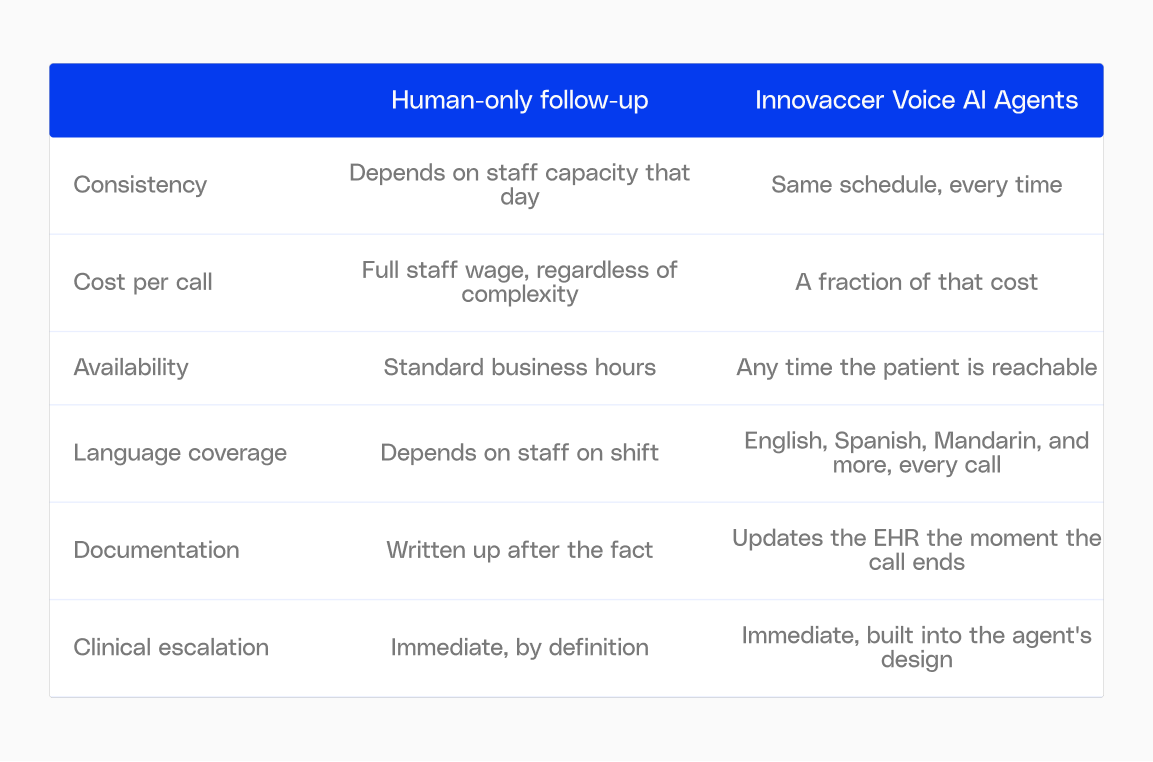
Runs on a fixed schedule, regardless of staff capacity. The agent should make the call whether or not your team had a busy day, not just when someone has time to trigger it.
Understands context, not just keywords. A good agent follows what the patient is actually saying across the whole call, not just matching against a script.
Escalates clinical answers immediately. Any answer that sounds like it needs a clinician should go straight to a person. The agent's job is to catch it, not to solve it.
Documents the interaction automatically. The call outcome should land directly in your EHR, not in a note someone writes up later.
Sounds like a person who remembers the patient. Chronic care follow-up works best when it feels like a check-in from someone familiar, not a generic survey read the same way every time.
Supports the patient's preferred language. Chronic conditions affect every population, and follow-up should not depend on which language a patient speaks.
How Innovaccer Voice AI Agents Meets Every One of These
Innovaccer Voice AI Agents, built on Innovaccer's Gravity platform, is designed around this exact list. It runs chronic care follow-up calls on a fixed schedule tied to each patient's care plan, so the call happens whether your team's day was quiet or overloaded. It follows the patient's context through the full conversation, recognizes answers that sound clinical, and escalates those to a person immediately rather than trying to resolve them itself. Every call outcome documents directly into your EHR, and the agent speaks English, Spanish, Mandarin, and other languages your patient population speaks, as a default setting rather than an add-on.
Health systems already using Innovaccer Voice AI Agents for scheduling and outreach have seen results like a 37% increase in completed appointments, without adding headcount. The same underlying agent runs chronic care follow-up, transitional care management outreach, and program enrollment calls, so a health system is not standing up a different tool for every call type.
Human-Only Follow-Up vs. Innovaccer Voice AI Agents
Where Chronic Care Fits Into Voice AI for Healthcare
Chronic care follow-up is one piece of a bigger shift. The same AI voice agent for healthcare that runs chronic care check-ins can also handle scheduling, transitional care management follow-up after discharge, and program enrollment outreach. For most health systems, chronic care follow-up is the highest-value place to start, because it is high volume, low complexity per call, and the easiest to fall behind on when staff are stretched.
Frequently Asked Questions
What is chronic care management follow-up?
Chronic care management follow-up is a regular check-in call with a patient managing an ongoing condition, used to track symptoms, confirm medication adherence, and catch problems before they become emergencies.
Can an AI voice agent safely handle chronic care calls?
Yes, when it is built to escalate rather than resolve. A safe AI voice agent for chronic care follow-up recognizes clinical answers and hands them to a person immediately, instead of trying to give medical advice itself.
Does voice AI replace nurses or care coordinators?
No. An AI voice agent for chronic care follow-up takes the routine, scheduled check-in calls off a care team's plate, so nurses and care coordinators spend their time on patients who need direct clinical attention.
How is this different from an automated phone survey?
A phone survey follows a fixed script and matches keywords. A real AI voice agent follows the conversation in context, recognizes when an answer is a clinical flag, and escalates it, rather than just logging a response.
What happens if a patient needs urgent help during the call?
The agent escalates the call to a person immediately. It is built to recognize urgency and hand off, not to handle a medical emergency on its own.
Learn more here: