.png)
.png)
You already know the effort it takes to collect social and clinical data. Screening programs are in place, community partners are active, and EHRs capture more structured information than ever before.
Yet the outcomes remain inconsistent. Preventable readmissions continue to strain capacity. Equity goals slip behind. Clinical teams still react to risk rather than anticipate it.
Your data systems were designed for compliance and documentation, not to predict what comes next. EHRs document encounters. Claims report utilization. Social assessments live in spreadsheets or disconnected systems.
Predictive analytics changes that. By connecting clinical, claims, and social data, you can forecast future outcomes with precision. When predictive models incorporate social determinants of health such as housing instability, social isolation, and financial stress, they expose risk patterns that traditional models miss. The result is foresight that helps you act before a patient’s condition turns critical.
Scaling Predictive Analytics Across Systems: Turning Data into Foresight
The experience of MercyOne shows how even high-performing systems struggle to translate fragmented data into timely, predictive action.
At MercyOne, one of the largest integrated health systems in Iowa, leaders faced a familiar challenge: their data wasn’t keeping pace with their mission. Clinical data lived in one system, claims in another, and social risk data sat in spreadsheets or PDFs that rarely reached care teams in time to change an outcome.
The result was reactive care, rising readmissions, and resource strain that undercut population health goals.
MercyOne partnered with Innovaccer to unify and activate its data. Within months, what had once been months of lagging information became daily predictive updates. Care teams gained foresight that reduced readmissions, improved coordination, and helped clinicians act before patient risk escalated.
Explore the full MercyOne transformation story here.
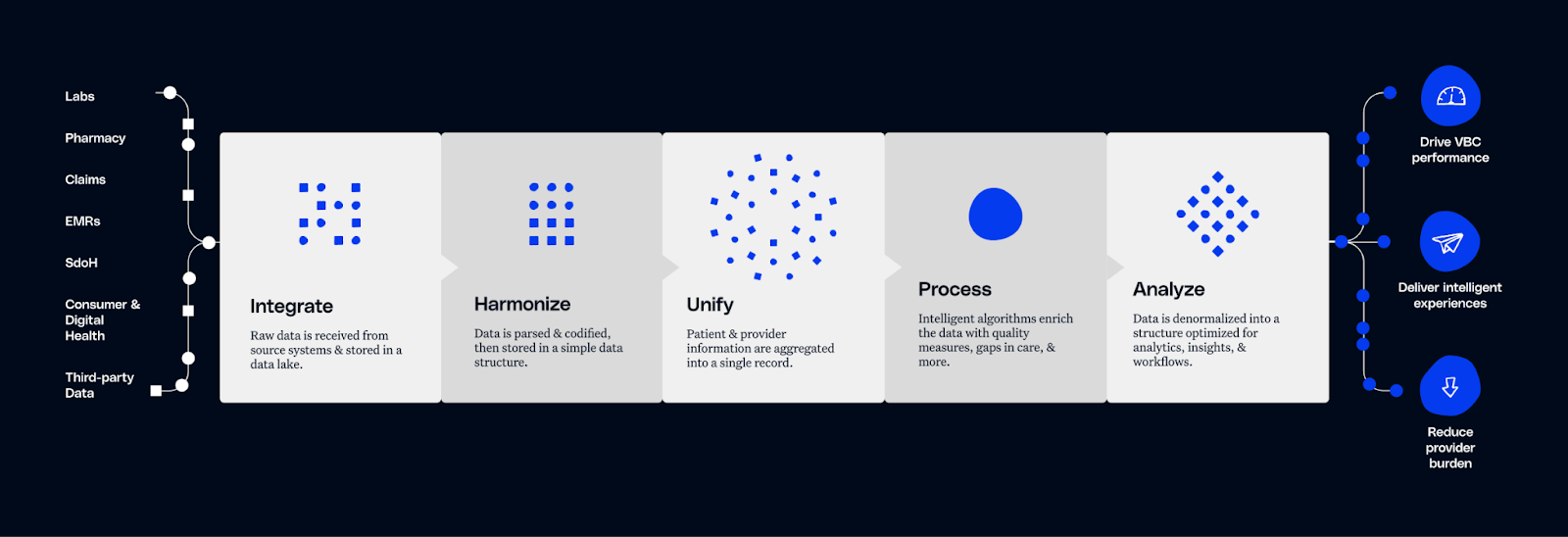
Innovaccer’s Healthcare Intelligence Platform begins by integrating raw data from EHRs, claims, labs, and community sources into a secure data lake.
It then harmonizes that information: parsing, standardizing, and codifying it into a unified format that makes data comparable across systems.
It then integrates each patient and provider record into a unified longitudinal view. Each update-a new diagnosis, prescription refill, or community referral-refreshes automatically so predictive models are always reflecting real-world conditions.
As the unified data is being processed through the system, intelligent algorithms enrich that data with quality measures, care gaps, and utilization trends.
The data are analyzed and transformed into the most optimum structure for predictive modeling and AI-based forecasting.
The result is a foundation where data no longer lags behind care. If a patient's status in housing changes or a new comorbidity appears, their risk scores are updated in real-time.
These insights surface directly within the tools your teams already use.
- Physicians see risk scores and SDOH drivers directly within the EHR to identify and intervene with rising-risk patients during their visits.
- Care managers receive ranked worklists that flag who needs outreach first and why, improving outreach efficiency and closing care gaps sooner.
- Population health leaders monitor shifting risk trajectories across cohorts in near real time to inform resource allocation, intervention planning, and performance tracking against equity and quality goals.
Each interaction is a point of decision, not another report to be interpreted.
Every prediction made is transparent and explainable. Innovaccer's models show which variables are driving that risk, helping clinical and analytics leaders understand exactly why a patient is being flagged. That kind of transparency builds trust and accelerates adoption across teams.
With time, the platform learns from every encounter, every referral, every intervention. This continuous feedback loop turns analytics into a living capability: one that sharpens forecasts, aligns interventions, and sustains predictive accuracy as populations evolve.
With this intelligence foundation, predictive analytics becomes a system-wide competency.
You move from aggregating data to activating it.
From monitoring outcomes to shaping them in real time.
And from reacting to risk to anticipating it, with every decision informed by context.
The Leadership Imperative: Turning Predictive Insight into Operational Advantage
For healthcare leaders, the next step is operationalizing existing intelligence. That shift depends on three essentials:
- Data quality that ensures SDOH, clinical, and claims inputs are normalized and comparable.
- Model utility that ties every prediction to measurable outcomes.
- Workflow activation that delivers insights directly where care decisions are made.
With Innovaccer’s unified intelligence foundation, those three components work together. Predictive analytics becomes part of your system’s DNA: continuously learning from every encounter, referral, and follow-up.
When predictive intelligence becomes part of your operating rhythm, your teams stop chasing data and start shaping outcomes. You see risk before it becomes readmission. You design equity into every care plan. You lead with foresight, not hindsight.
That is what it means to see beyond the chart. Discover how Innovaccer helps health systems turn SDOH insight into predictive precision and see what predictive intelligence looks like in action. Book a demo today.