.png)
.png)
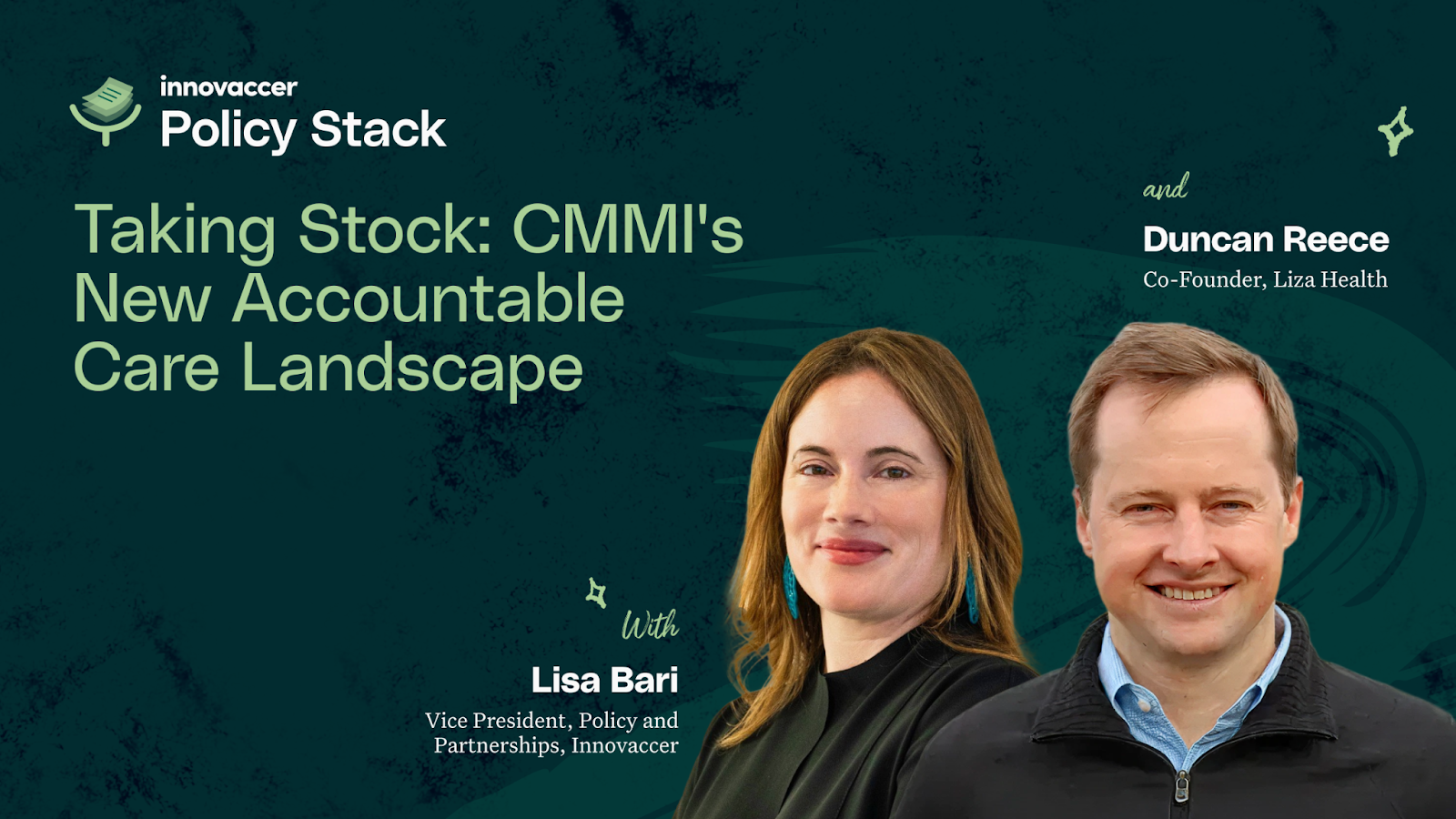
Duncan Reece got his start in value-based care before it was called that, participating in Medicare Health Support—a demonstration of telephonic disease management. From co-founding Health Dialogue to joining Iora Health in its early days, and now at Liza Health, Reece has spent two decades navigating the evolution from fee-for-service to accountability-based payment models. Now, as the Center for Medicare and Medicaid Innovation launches seven new models in a single quarter—including the ACO REACH successor LEAD, and the tech-enabled chronic care model ACCESS—Reece offers a crucial perspective on what this unprecedented wave of innovation actually means for operators. Here are key insights from Lisa Bari's conversation with Duncan Reece on the Policy Stack Podcast:
1. Different Payment Is Necessary But Not Sufficient
Reece emphasizes a foundational truth: payment reform alone doesn't create high-value care. While critics focus on "moving money around" through benchmark gaming and risk adjustment optimization, they're actually criticizing value-based payment, not value-based care. The real question is whether organizations are delivering high-value care as defined by Michael Porter: better outcomes at lower costs with improved patient experience. Some MSSP organizations, particularly provider-focused ACOs, have demonstrated genuine success. Others have figured out how to profit from coding better without changing how medicine is actually delivered to patients. This is why continued experimentation with oversight, quality evaluation, and clinician experience measurement remains essential.
2. All Payment Models Can Be Gamed
When people criticize value-based care for gaming and optimization, Reece points out the obvious: fee-for-service has massive waste, abuse, fraud, and unnecessary billing. Value-based payment simply has different flavors of money moving around. The goal shouldn't be finding a perfect silver bullet payment model—it doesn't exist. Instead, the focus should be on developing better models with appropriate oversight and ensuring accurate coding. If you're paid on something adjusted by coding (whether risk adjustment or fee-for-service), you should determine the right codes for procedures and conditions. The problem isn't coding itself, it's when coding becomes divorced from actual care delivery changes.
3. Technology Requirements Have Been Barriers to Innovation, Not Enablers
Ten years ago when companies like Iora were building new primary care models, certified EHR requirements created massive obstacles. Iora built its own EHR from scratch - eventually getting it certified, but that process took years of engineering effort focused on compliance requirements rather than features that actually moved the needle with patients. On Iora's first day of operations in Las Vegas serving Culinary Union members with significant chronic diseases, their EHR didn't work. It turned out not to matter: doctors, nurses, health coaches, and medical assistants took care of patients by writing things down on paper, which people had done for a long time. This forced focus on what actually mattered: getting the right people in the right order, treating their needs, and building relationships. Technology became a tool to support care, not the centerpiece.
4. The Technology Unlock Is Finally Here
The cost of developing healthcare technology is going down significantly, which means the cost of accessing those technologies is dropping too. Paradoxically, healthcare now shows some of the best AI adoption of any industry—the opposite of how it used to be, when you had to literally pay people to use new healthcare technology. This shift reflects both how antiquated existing systems are (with minimal automation) and how desperate providers are for something different. New capabilities include headless EHRs that are ONC-certified with incredible interoperability, allowing custom experiences rather than being locked into Epic or other monolithic systems. Health Information Networks now enable reliable access to all patient records with the push of a button, eliminating the task burden of gathering medical records that previously dominated practice workflows.
5. Focus Only on Models Relevant to You
Reece admits he wasn't even aware of some of the seven models Lisa mentioned because he purposely doesn't track everything CMS announces. This represents the advantage of being an operator: focus on things that matter to your organization. For large hospital systems, this creates genuine challenges because arguably every single model is relevant to them. Without dedicated "skunk work" projects that are protected from business-as-usual operations, it's unclear how large organizations can organize people, processes, and change around a portfolio of models. This reinforces a broader question: does it make sense to go to one big building for everything you need, or are we better off having specialty-focused organizations for different aspects of care with much more tailored experiences, technology, and support?
6. The Ten-Year Time Horizon and Benchmark Changes Signal Real Conviction
The shift to ten-year time horizons for models like LEAD and ACCESS, versus traditional three- or four-year demonstrations, represents meaningful progress. While these models can still be canceled (nothing is guaranteed), the longer commitment should increase confidence for operators and, importantly, help set the tone for frontline clinicians who are nervous about payment reform. The removal of benchmark ratcheting in LEAD addresses one of the biggest barriers to commercial insurance adoption of value-based payment. The ratchet has been particularly penalizing in lower-acuity populations, making it difficult for providers to sustain success over time. By demonstrating these modifications can work in Medicare, CMS may finally unlock broader market adoption beyond government programs.
Listen to the full Policy Stack Podcast episode here.