.png)

Artificial intelligence scheduling uses data-driven automation to adjust appointment availability, match patients with appropriate providers, and respond to changes, while traditional healthcare scheduling relies on manual procedures and preset templates that require staff intervention. Traditional systems often need human intervention to make adjustments, leading to inefficiencies and delays.
The Inefficiency Trap
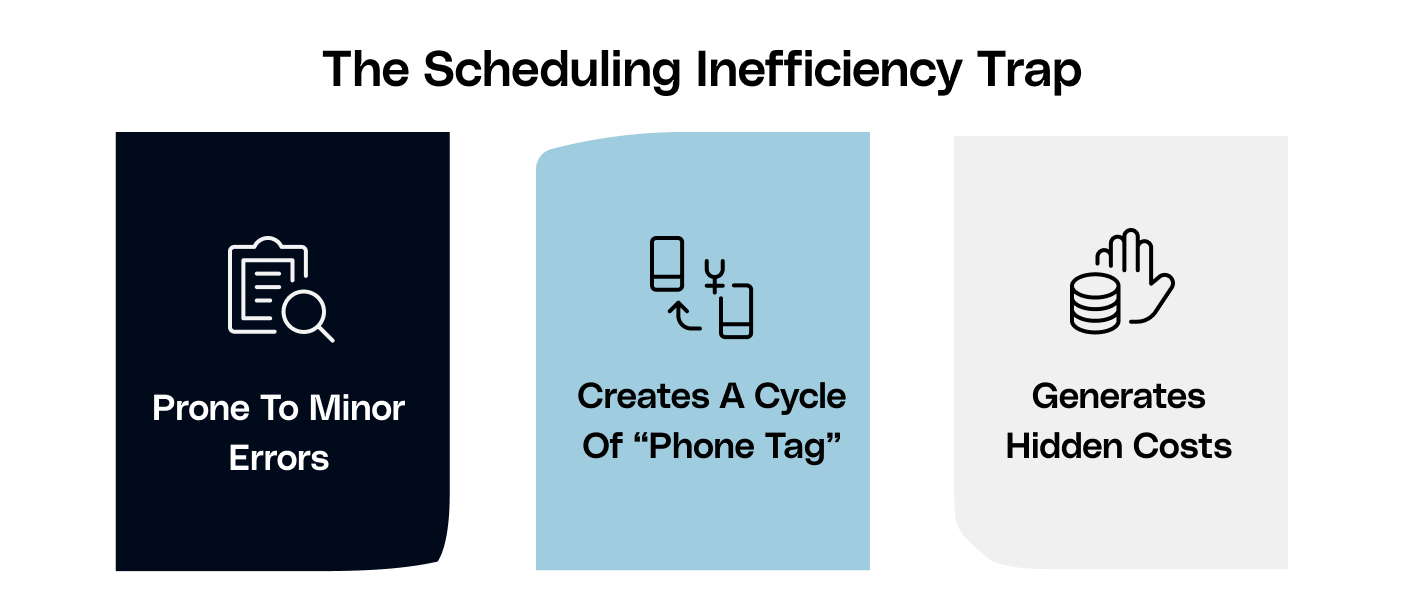
Traditional Healthcare Scheduling Methods Overview
Poor traditional scheduling techniques can frequently result in doctors working through challenging patients back to back without enough breaks, or in periods of high busyness followed by idle time. Insufficient time allocation also creates impossible expectations for physicians, who face the daily dilemma of rushing through appointments because the same brief time slot is allotted regardless of a patient's actual needs. This inconsistency does not let physicians stick to a particular rhythm, contributing to mental and physical exhaustion.
Long wait times for appointments force patients to wait before receiving necessary care, and the psychological burden of waiting while experiencing concerning symptoms adds to that suffering. Limited scheduling options also disproportionately affect populations facing logistical challenges, such as single parents, workers without paid time off, and people who depend on public transportation.
Patient Frustration Points

Benefits of AI Scheduling in Healthcare
AI systems enable 24/7 self-scheduling for patients through portals and mobile apps. By optimizing provider schedules, prioritizing urgent cases, and quickly filling cancellations, AI patient scheduling tools such as Innovaccer's Comet elevate the patient experience and substantially reduce wait times between needing and receiving care. Franciscan Health saw a 37% increase in appointment scheduling after deploying Comet's AI agents. Appointments also become more personalized, since AI can match patients with providers based on clinical specialization, language ability, past relationships, and communication preferences.
Differences Between Artificial Intelligence Scheduling and Traditional Scheduling in Healthcare
Traditional AI-Driven Business-hours availability 24/7 self-scheduling through portals and apps Fixed time slots regardless of need Provider schedules optimized around case complexity Manual waitlist management Cancellations filled quickly and automatically Generic provider assignment Matching based on specialization, language, and preference
Benefits of AI Scheduling in Healthcare: Addressing Healthcare Disparities
AI scheduling also helps address healthcare disparities by expanding access points, such as adjusted clinical hours and transportation assistance for underserved groups. It can provide digital navigation assistance for patients with limited digital access, multilingual interfaces for those with diverse language needs, and accessibility features for patients with disabilities.
AI Scheduling Impact on Healthcare Efficiency
Implementing AI scheduling carries the possibility of a fast return on investment. Administrative costs decrease as time-consuming tasks are automated, shifting staff focus from manual schedule adjustments to higher-value patient care activities. Balanced schedules also give physicians appropriate time between complex cases and documentation, which has a direct impact on clinical outcomes and patient experience.
Challenges of Implementing AI Scheduling in Healthcare
Implementation challenges include integration with existing systems, inconsistent scheduling data, workflow redesign, staff adoption, privacy and security governance, patient accessibility, and ongoing performance monitoring. Healthcare administrators and leaders need to identify which aspects of their current scheduling process work well and should be preserved, then augment those strengths with AI capabilities that address existing pain points. A phased rollout can test workflows, safety, equity, and operational effects before broader deployment.
FAQs
What is artificial intelligence scheduling in healthcare? Artificial intelligence scheduling is the use of automated, data-driven systems to manage appointment availability, match patients with the right provider, fill cancellations, and adjust schedules in real time, replacing the manual, template-based processes traditional scheduling relies on.
How does AI scheduling reduce no-shows? AI scheduling can reduce no-shows by identifying appointments at higher risk and triggering personalized outreach instead of sending one generic reminder to everyone. Health systems should validate the model, outreach rules, and observed effect in their own setting.
Is AI scheduling secure for patient data? AI scheduling can support secure patient-data handling when privacy, security, and legal requirements are built into its design and operation. Infrastructure, access controls, and audit trails are relevant safeguards, but they do not establish compliance by themselves.
Does AI scheduling replace call center staff? AI scheduling is designed to automate routine scheduling volume while allowing staff to focus on complex cases and patients who need human assistance. Workforce effects depend on workflow design, adoption, and local operating decisions.
What are the challenges of implementing AI scheduling in healthcare? The main challenges are integrating AI with existing systems, improving data quality, redesigning workflows, defining governance, protecting patient information, maintaining accessible non-digital options, training staff, and monitoring performance. A phased rollout should preserve effective processes, address specific pain points, and test safety, equity, and operational effects before expansion.
Experience this transformative approach firsthand by scheduling a demo of Innovaccer’s solutions today.