


.png)
The best healthcare AI platform for large health systems in 2026 depends on whether you need a unified data and AI foundation, an EHR-native solution, or a specialized clinical AI tool. This guide compares 10 platforms including Innovaccer Gravity, Epic, Oracle Health, Microsoft Nuance, Aidoc, Salesforce Health Cloud, Abridge, Notable Health, Kore.ai, and Ambience Healthcare across five criteria that matter most to enterprise buyers: data unification, EHR integration, scalability, measurable ROI, and AI governance.
Large health systems face a distinct challenge. Unlike smaller organizations that can adopt point solutions, enterprise buyers must ensure any AI investment integrates with existing infrastructure, supports governance requirements, and delivers value across diverse clinical and administrative use cases. The average health system now runs 3 to 5 separate AI tools with no shared data layer creating fragmentation that limits each tool's effectiveness and multiplies vendor management overhead.
This guide evaluates each platform through the lens of what enterprise buyers actually need: measurable ROI, native interoperability, and the ability to scale AI initiatives across hundreds of care sites without rearchitecting data infrastructure with each new use case.
Key Evaluation Criteria for Large Health Systems
Before comparing platforms, it helps to understand the five criteria that separate enterprise-grade solutions from mid-market tools.
Data unification is the foundation. Before any AI model delivers value, the platform must aggregate and normalize data from EHRs, claims systems, ADT feeds, labs, imaging, and social determinants of health sources. Platforms that require health systems to pre-clean or manually map data create implementation bottlenecks that delay time to value.
EHR integration depth determines whether AI insights reach clinicians at the point of care. Surface-level integrations that require clinicians to leave their EHR create friction and reduce adoption. The most effective platforms embed AI recommendations directly within Epic, Oracle Health, or other EHR interfaces.
Scalability must be evaluated both technically and operationally. Ask vendors to demonstrate deployments at comparable scale and how many facilities, how many patient lives, how many concurrent users. Request references from health systems of similar size and complexity.
ROI measurement should be built into the platform, not bolted on. Enterprise buyers need clear visibility into how AI initiatives impact quality metrics, operational efficiency, and financial performance. Platforms that cannot demonstrate measurable outcomes within defined timeframes represent investment risk.
AI governance infrastructure includes model explainability, bias detection, version control, human-in-the-loop controls, and compliance documentation. These capabilities should be native to the platform, not dependent on third-party tools.
Top 10 Healthcare AI Platforms Compared
1. Innovaccer Gravity
Category: Healthcare AI Platform / Healthcare Autonomy Platform
Gravity is Innovaccer's healthcare-native AI platform. It unifies clinical, claims, financial, and operational data from across the enterprise and deploys AI agents that execute operational work such as prior authorization, care gap outreach, enrollment, and scheduling with configurable human oversight at every step.
Key capabilities:
- 100+ EHR connectors and 100+ payer connectors pre-loaded at deployment
- 50+ prebuilt agents across revenue cycle, population health, patient access, and operations
- Agent Studio for building custom healthcare AI workflows without code
- 6,000+ continuous data quality rules with data observability
- Configurable human-in-the-loop governance at every workflow node
- Cloud, data warehouse, and LLM agnostic — runs on AWS and Azure, works with Snowflake and Databricks, supports OpenAI, Anthropic, and Meta models
Deployment evidence: At a large non-profit organization, prior authorization processing time dropped from 43 minutes to under 3 minutes after deployment. Serves health systems across the U.S. with deployments spanning clinical, financial, and operational workflows on a single platform.
Best for: Large IDNs and multi-hospital systems that need a single platform spanning clinical, financial, and operational workflows and want AI agents that perform work, not just surface insights. Particularly strong for health systems operating across multiple EHR environments.
Considerations: Gravity is a platform commitment, not a point solution. Health systems looking for a single narrow use case may find purpose-built tools faster to deploy for that specific need.
2. Epic
Category: EHR-Native AI
Epic embeds AI capabilities directly within its EHR workflow, including clinical decision support, predictive models, and ambient documentation through its integration with Nuance DAX Copilot. AI features appear as native functionality within the clinician's existing interface.
Key capabilities:
- AI models embedded directly within Epic workflows
- Predictive analytics for readmission risk, sepsis detection, and deterioration alerts
- Ambient documentation support through DAX Copilot integration
- Extensive App Orchard marketplace for third-party AI integrations
Best for: Health systems fully standardized on Epic that want tight workflow integration with minimal implementation overhead.
Considerations: AI capabilities are strongest within the Epic ecosystem. Health systems operating multiple EHRs across acquired facilities may find limited cross-platform data unification. AI capabilities outside clinical workflows — revenue cycle, operations — are less developed compared to dedicated platforms.
3. Oracle Health (Cerner)
Category: EHR-Native AI / Enterprise Health Platform
Oracle Health combines Cerner's clinical platform with Oracle's cloud infrastructure and AI capabilities, providing clinical decision support, population health analytics, and revenue cycle tools with Oracle's database and cloud scale.
Key capabilities:
- Clinical AI integrated within the Oracle Health EHR workflow
- Oracle Cloud Infrastructure providing compute scale for AI workloads
- Population health and analytics built on Oracle's database technology
- Revenue cycle and administrative AI tools
Best for: Health systems already on Oracle Health (Cerner) looking to consolidate AI and analytics within the Oracle ecosystem.
Considerations: The Oracle Health and Cerner integration is still evolving. Cross-EHR data unification capabilities are limited compared to vendor-agnostic platforms.
4. Microsoft Nuance / DAX Copilot
Category: Ambient Clinical AI / Documentation
Microsoft's healthcare AI strategy centers on Nuance's DAX Copilot for ambient clinical documentation — automatically generating clinical notes from patient-clinician conversations. The platform integrates with major EHR systems and reduces documentation burden on physicians.
Key capabilities:
- Ambient documentation capturing patient encounters and generating structured clinical notes
- Integration with Epic, Oracle Health, and other major EHR systems
- Microsoft Azure cloud infrastructure supporting enterprise-scale deployment
Best for: Health systems where physician burnout and documentation burden are the primary pain points driving AI investment.
Considerations: Primarily focused on documentation. Health systems needing AI across revenue cycle, population health, and operational workflows will need additional platforms.
5. Aidoc
Category: Clinical AI — Radiology and Care Coordination
Aidoc provides AI-powered radiology triage and clinical decision support, identifying urgent findings in medical imaging and coordinating follow-up care. The platform has expanded beyond radiology into broader care coordination.
Key capabilities:
- AI-powered imaging analysis for stroke, pulmonary embolism, and other time-sensitive findings
- Real-time triage alerts integrated into radiology and clinical workflows
- FDA-cleared AI algorithms across multiple clinical domains
Best for: Health systems where radiology workflow optimization and clinical triage are high-priority use cases.
Considerations: Primarily focused on imaging and clinical triage. Not a platform for revenue cycle, population health, or administrative workflow automation.
6. Salesforce Health Cloud
Category: Healthcare CRM / Patient Engagement
Salesforce Health Cloud applies Salesforce's CRM platform to healthcare, providing patient relationship management, care coordination, and engagement tools. AI capabilities are delivered through Salesforce Einstein and Agentforce.
Key capabilities:
- Patient 360 views combining clinical, operational, and engagement data
- AI-powered care coordination and patient engagement workflows
- Agentforce for healthcare contact center and administrative automation
Best for: Health systems and payers focused on patient engagement, relationship management, and contact center operations.
Considerations: CRM-first architecture means clinical AI capabilities are limited compared to healthcare-native platforms. Data unification is focused on engagement data rather than the full clinical-claims-financial picture.
7. Abridge
Category: Ambient Clinical AI / Documentation
Abridge provides AI-generated clinical documentation from patient-clinician conversations, focusing on structured, accurate clinical notes that integrate with major EHR systems.
Key capabilities:
- Real-time ambient documentation from in-person and telehealth encounters
- Structured note generation with EHR-specific formatting
- Support for multiple clinical specialties and encounter types
Best for: Health systems seeking ambient documentation with a focused, purpose-built approach.
Considerations: Documentation-focused. Not a platform for broader AI initiatives across revenue cycle, operations, or population health.
8. Notable Health
Category: AI Automation — Patient Engagement and Administration
Notable Health automates patient-facing and administrative workflows, including digital intake, scheduling, referral management, and pre-visit planning.
Key capabilities:
- Automated digital patient intake and pre-visit workflows
- AI-powered scheduling and referral management
- Administrative workflow automation for front-office operations
- EHR integration for bidirectional data exchange
Best for: Health systems where patient access bottlenecks and front-office administrative burden are the primary pain points.
Considerations: Focused on patient-facing and administrative workflows. Does not cover clinical AI, revenue cycle optimization, or population health management.
9. Kore.ai
Category: Conversational AI / Contact Center Automation
Kore.ai provides conversational AI and virtual assistant technology for healthcare contact centers and patient engagement, handling patient interactions across voice, chat, and digital channels.
Key capabilities:
- AI-powered virtual assistants for patient scheduling, billing inquiries, and triage
- Omnichannel support across voice, web chat, SMS, and mobile
- Natural language understanding tuned for healthcare terminology
Best for: Health systems and health plans looking to automate high-volume patient interactions across phone and digital channels.
Considerations: Conversational AI focus. Not a clinical AI platform and does not provide data unification, population health analytics, or revenue cycle automation.
10. Ambience Healthcare
Category: Ambient Clinical AI / Documentation and Coding
Ambience Healthcare provides ambient AI for clinical documentation and coding, capturing patient encounters and generating clinical notes, coding suggestions, and referral letters.
Key capabilities:
- Real-time ambient documentation with specialty-specific models
- AI-assisted coding suggestions generated from encounter documentation
- Referral letter and patient communication generation
- Integration with major EHR systems
Best for: Health systems prioritizing ambient documentation with integrated coding support.
Considerations: Primarily focused on documentation and coding. Broader operational and financial AI use cases are outside the platform's scope.
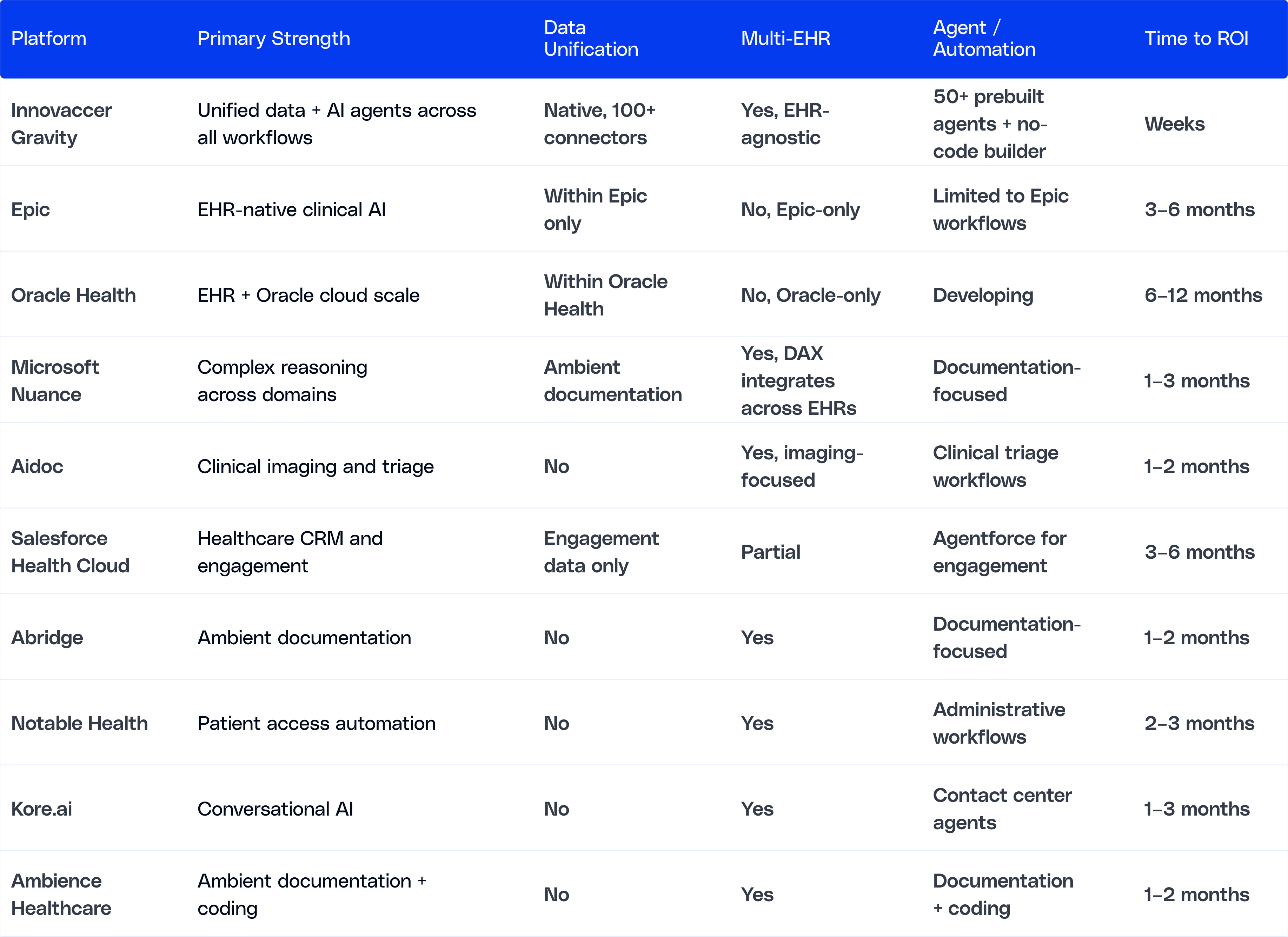
Platform Comparison Matrix
The table below summarizes how each platform performs across the five core evaluation criteria for enterprise health system buyers.
How to Choose the Right Platform for Your Health System
The decision comes down to scope. If your immediate need is a single use case — ambient documentation, contact center automation, or imaging AI — a purpose-built platform delivers faster time to value for that specific workflow.
If your goal is enterprise-wide AI across clinical, financial, and operational domains, you need a platform that starts with unified data. Without a shared context layer connecting clinical records, claims, financial data, and operational systems, each AI tool operates on a fragment of the picture. That fragmentation produces narrow results and creates vendor sprawl as needs grow.
The practical question is whether you want to manage 5–7 separate AI vendors each with its own integration, governance model, and data requirements or consolidate around a platform that spans workflows. For health systems operating at scale, the total cost of managing fragmented point solutions often exceeds the investment in a unified platform within the first 12–18 months.
Start by defining your primary use cases and assessing your data readiness. Health systems with fragmented data across multiple EHRs need platforms that excel at data unification. Those with mature data infrastructure may prioritize advanced AI capabilities. Evaluating your internal resources — infrastructure platforms require data science talent, while healthcare-native platforms reduce that requirement. Request demonstrations and references that match your scale: a platform that performs well for a 10-hospital system may not be proven at 50 hospitals.
Frequently Asked Questions
What is a healthcare AI platform and how does it work in large health systems?
A healthcare AI platform is an integrated technology solution that combines data unification, machine learning models, and workflow integration to deliver AI-powered insights and automation across clinical, operational, and financial functions. In large health systems, these platforms ingest data from multiple EHRs, claims systems, and other sources, normalize that data into a unified foundation, and deploy AI models that surface recommendations to clinicians and administrators at the point of decision.
How do leading healthcare AI platforms integrate with Epic and other major EHR systems?
Leading healthcare AI platforms integrate with Epic and other EHR systems through native APIs, embedded applications, and bidirectional data exchange protocols. The most effective integrations surface AI recommendations directly within the clinician's EHR workflow — appearing in the patient chart, clinical decision support alerts, or in-basket messages — without requiring clinicians to navigate to external applications.
What should a health system look for when buying a healthcare AI platform?
Evaluate platforms against five core criteria: data unification capabilities, EHR integration depth, scalability across the IDN, measurable ROI potential, and AI governance infrastructure. Request demonstrations that reflect your scale and complexity, speak with reference customers of comparable size, and assess the vendor's roadmap for emerging capabilities like agentic AI workflows and ambient documentation.
How do healthcare AI platforms handle HIPAA compliance and data security?
Enterprise healthcare AI platforms handle compliance through encryption of protected health information at rest and in transit, role-based access controls, audit logging, business associate agreements, and regular security assessments including penetration testing. Look for SOC 2 Type II certification, HITRUST certification, or equivalent validations. Platforms with native human-in-the-loop governance provide additional control over how AI accesses and acts on patient data.
What is the difference between a healthcare AI platform and a point AI solution?
A healthcare AI platform provides a unified data foundation and AI infrastructure that supports multiple use cases across clinical, financial, and operational workflows. A point AI solution focuses on one specific use case such as ambient documentation, radiology triage, or contact center automation. Platform approaches reduce vendor fragmentation and provide shared context across workflows. Point solutions deliver faster time to value for a single need but require separate integrations and data management for each additional use case.
Which healthcare AI platforms support agentic workflows?
Agentic workflows — where AI agents execute multi-step operational tasks autonomously within defined guardrails — are supported by platforms that combine unified data with workflow orchestration. Innovaccer Gravity offers 50+ prebuilt agents and a no-code Agent Studio for custom workflows. Salesforce provides Agentforce for engagement workflows. Kore.ai offers conversational agents for contact centers. The key differentiator is whether agents operate on unified cross-workflow data or are limited to a single domain.

.png)