


.png)
.png)
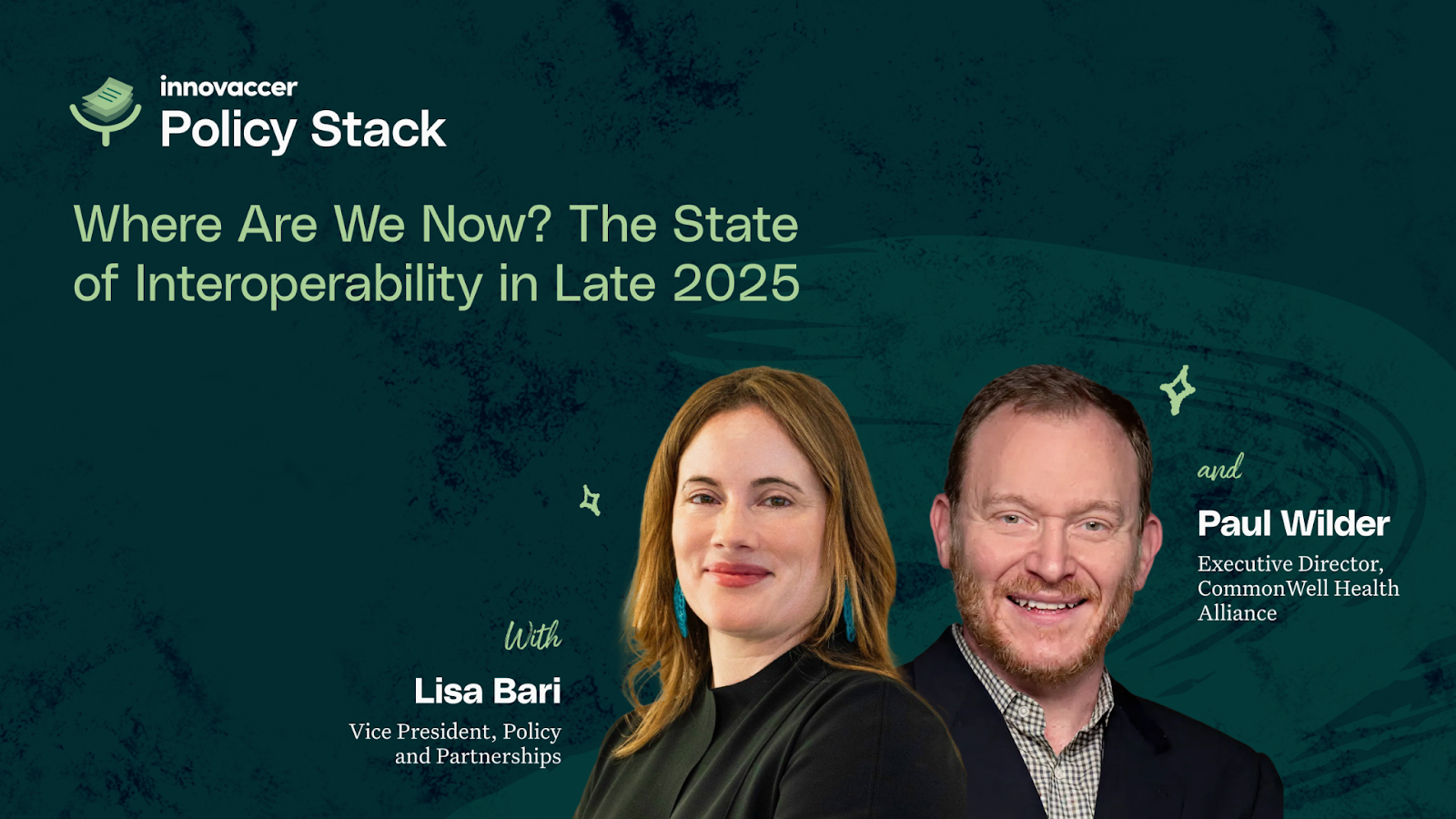
Paul Wilder has been working in health IT since well before interoperability became a national mandate. From helping thousands of providers across New York State navigate meaningful use, to leading CommonWell Health Alliance and the CommonWell Network as it evolved into a TEFCA Qualified Health Information Network, his career tracks the industry’s long push toward connected care. In a recent conversation with Lisa Bari on the Policy Stack Podcast, Wilder offered a candid assessment of where interoperability is succeeding, where it is stalling, and what still needs to change.
1. Treatment Data Exchange is Functioning at Scale, but Usefulness still Lags
Wilder is clear that treatment-related interoperability mandates are largely working. Data are moving, and at high volumes. The challenge begins once that data lands inside clinical systems. Providers often lack effective ways to interpret, normalize, and trust information they did not generate themselves. Documentation styles vary widely, context is inconsistent, and important details are buried in unfamiliar formats. While early AI tools are beginning to help summarize and surface relevant insights more quickly, these capabilities are still evolving. As a result, the gap between data availability and real clinical usability remains one of the industry’s most persistent problems.
2. The Biggest Interoperability Gaps Exist in the “Crossing of the P’s”
While treatment exchange happens in the hundreds of millions of transactions, other forms of data exchange lag far behind. Provider-to-payer, provider-to-public health, provider-to-patient, and hybrid combinations of these relationships (the Ps) are nowhere near the same level of maturity. Patient access, in particular, remains strikingly limited and often generates only hundreds of transactions per month. This disparity highlights a disconnect between public rhetoric and operational reality. Much of the industry’s interoperability progress has focused on treatment workflows, while the more complex business-to-business exchanges continue to struggle.
3. Patients Need Data Access
Wilder does not deny that many patients find their health data difficult to interpret. But he challenges the idea that this justifies limiting access. Healthcare data was designed primarily for operational and clinical transactions between organizations, not for patient consumption. Even so, patients play an essential role as a quality control layer. Errors are common across healthcare systems, and those errors often follow a patient for years, confusing clinicians and undermining downstream analytics and AI-driven decision support. Giving patients access to their data is not about making them experts. It is about giving them the chance to help correct the record before mistakes compound.
4. Networks should Support Small Payers
According to Wilder, it is inevitable that large EHR vendors and large payers will continue to establish direct connections with one another. The transaction volumes justify the cost, and direct integrations reduce per-transaction friction at scale. Networks should not try to compete in that space. Their real value lies in supporting the long tail, including smaller payers, regional plans, and public programs that will never have the leverage to negotiate hundreds of direct connections. In this role, networks act as transaction clearing mechanisms, enabling exchange between parties that otherwise would never connect. Financially, this means treatment exchange remains the anchor use case, even as other exchanges develop more gradually.
5. Electronic Prior Authorization is the Clearest Network Opportunity
Electronic prior authorization stands out as a use case where incentives finally align. Many high-cost therapies require supporting documentation from multiple specialists, not just the ordering physician. Today, this coordination often happens through fragmented portals and web-based forms that increase administrative burden and delay care. Networks are uniquely positioned to manage these multi-party exchanges more efficiently than point-to-point integrations. The benefits are shared. Payers reduce administrative costs, providers get faster decisions, and patients experience fewer delays. It is one of the few interoperability scenarios with both operational urgency and clear policy relevance.
To hear the full conversation and Wilder’s reflections in his own words, listen to the complete Policy Stack Podcast episode here.
.png)
