Inside Our AI-Enabled API Framework for Smarter Documentation




In today's data-driven landscape, connecting disparate systems through APIs remains one of the most time-consuming and error-prone technical challenges. Organizations typically spend weeks manually deciphering API documentation, writing custom code, and troubleshooting integrations—all before they can access the data they need.
The Hidden Cost of API Integration
At the heart of this inefficiency lies a surprisingly common issue: the complexity gap between API documentation and functional implementation. For example, we've worked with enterprise clients whose third-party API ecosystems contain hundreds of endpoints, complex authentication schemes, and interdependent data relationships, with documentation that fails to clearly map these connections.
When engineering teams are left to "figure it out" manually, the consequences can be severe:
- Extended timelines: API integration projects frequently exceed estimated delivery dates by 40-60%
- Resource drain: High-value engineers get bogged down in repetitive integration tasks
- Technical debt: Hastily implemented integrations lead to brittle, hard-to-maintain code
- Data quality issues: Manual orchestration frequently introduces data inconsistencies
Before you can perform analytics, build data products, or drive business intelligence initiatives, you must first solve the fundamental challenge of efficient API integration.
Introducing the AI-Enabled API Orchestration Framework
After experiencing this pain firsthand across dozens of projects, we built something I wish I'd had years ago: an AI-powered framework that does the heavy lifting of API integration for you.
This isn't just another "AI generates some code" tool that creates more problems than it solves. It's a comprehensive orchestration system built by engineers who've felt your pain:
- It actually reads and understands API docs (even the bad ones)
- Maps out the relationships between endpoints that documentation never explains
- Figures out authentication flows without you having to decipher crypto jargon
- Suggests the right endpoints based on the data you actually need
- Generates production-ready code that follows best practices
- Tests everything automatically so you're not flying blind
But the real magic? You can talk to it. Like, actually have a conversation about what you're trying to build.
How It Works: If Your Developer Friend Was Also an API Genius
Using our framework feels like pairing with a developer who's already integrated every API on the planet:
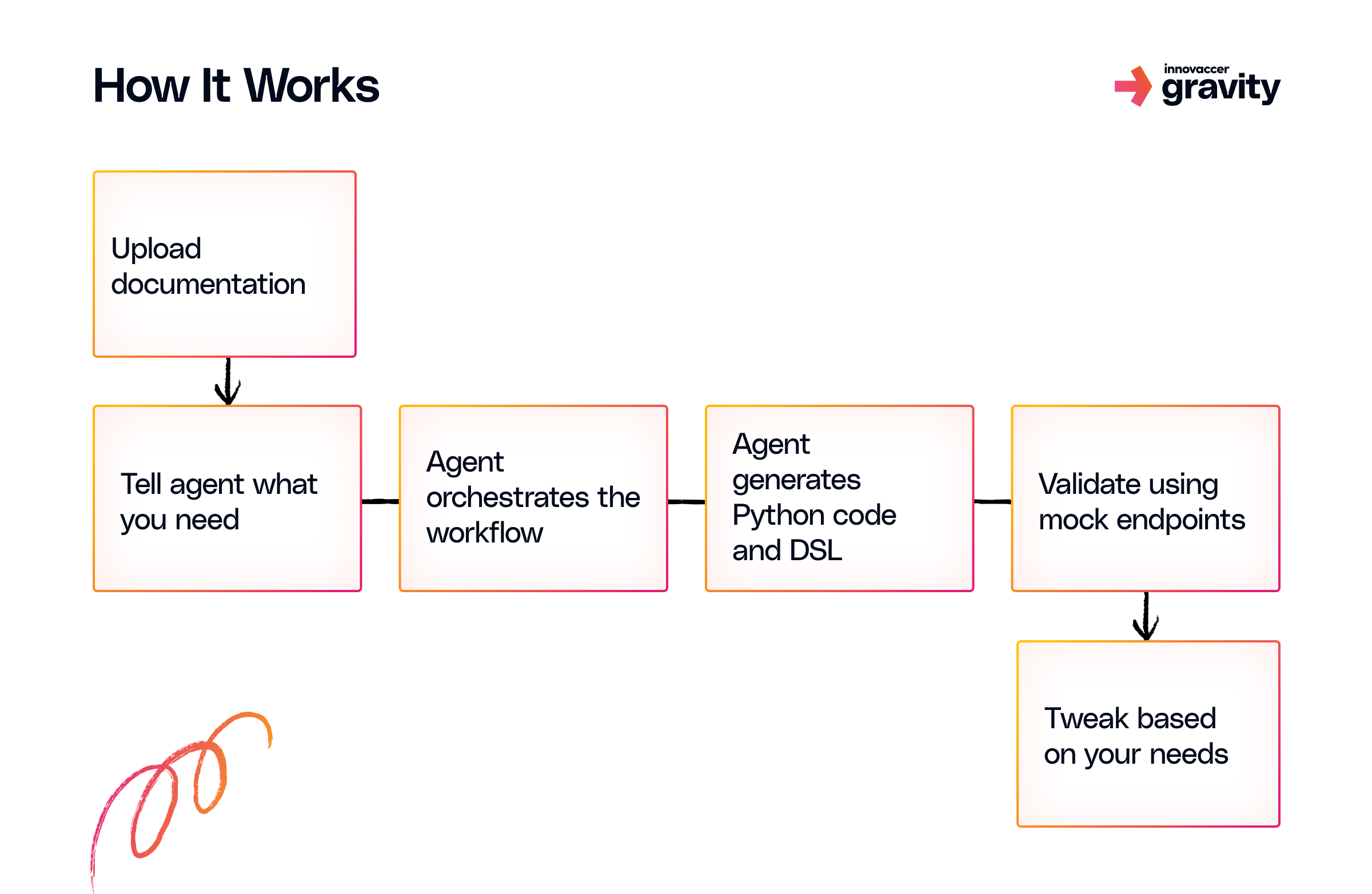
- Upload your docs and forget the headache - Throw any API documentation at it – Swagger, OpenAPI, even that outdated PDF from your vendor. The system extracts what matters and ignores the fluff.
- Have a conversation about what you need - Tell the AI agent what data you're after in plain language. "I need to pull transaction records for customers who signed up last month" is all it takes, not a detailed spec document.
- Let it figure out the hard parts - The system maps out which API calls depend on each other, how to handle pagination, which authentication flow to use, and builds an orchestration plan.
- Get code that actually works - Whether you need Python that fits your existing stack or Liquid templates for your no-code tooling, you get production-ready code with proper error handling included.
- Validate before you integrate - The framework automatically runs your flow against mock endpoints, checking for data completeness and logical consistency before you waste time with the real API.
- Tweak it through conversation - Want to change something? Just ask. "Can we add error retry logic" or "Let's filter out records older than 30 days" is all it takes.
Beyond the Buzzwords: Why This Actually Works
What makes this approach stick where others have failed is the combination of deep API knowledge with conversational guidance.
I should mention something critical here – this isn't a generic solution. We've cut our teeth on some of healthcare's most complex API ecosystems. After connecting to dozens of EHR systems, claims clearinghouses, and provider networks, we've encoded that specialized knowledge into our framework. When our system encounters a new healthcare API, it already understands common patterns for patient demographics, claims workflows, clinical data exchange, and FHIR resources.
Healthcare APIs are notoriously complex, often built on legacy systems with inconsistent standards and specialized workflows. By training our system on these challenging integrations first, we've created a solution that can handle virtually any API you throw at it – healthcare or otherwise. If it can navigate the labyrinth of healthcare data exchange, your e-commerce API doesn't stand a chance.
It's like having an API integration expert who never sleeps, never gets frustrated with poorly written documentation, and remembers every endpoint pattern they've ever encountered.
And because the system learns from each integration, it gets smarter about suggesting endpoints and handling edge cases over time. Each healthcare integration we complete makes the next one faster and more accurate.
Real-World Impact
While integrating a new EHR system, our framework reduced API integration time from 3 weeks to just 2 days, freeing our engineering team to focus on higher-value tasks while improving data quality and reducing maintenance overhead.
Whether you're a CTO focused on accelerating digital transformation, a data engineer drowning in API documentation, or a product manager trying to ship faster, this solution delivers:
- 90% reduction in time-to-implementation for new API integrations
- 75% decrease in engineering resources required for data acquisition
- Elimination of common integration errors and data quality issues
- Democratization of API integration capabilities across technical teams
Beyond Code Generation: A New Integration Paradigm
What makes our approach different is the seamless combination of AI-powered automation with human expertise. The agentic workflow allows technical teams to leverage their domain knowledge while eliminating repetitive implementation tasks.
The system continuously learns from each integration, building an understanding of common patterns and best practices that improves future suggestions and implementations.
Looking Forward
We believe we're witnessing the end of the era where engineers waste their talents on tedious API integration tasks. The future isn't about replacing developers – it's about letting them focus on the creative and strategic work that matters.
Our AI-enabled API framework represents a fundamental shift in how teams tackle data acquisition – moving from manual drudgery to creative collaboration with intelligent systems.om manual, error-prone processes to intelligent, automated orchestration

with the Power of Comet


.svg)
.svg)

.svg)