The Policy Stack Podcast #Ep 3: Key Lessons from Dan O'Neill




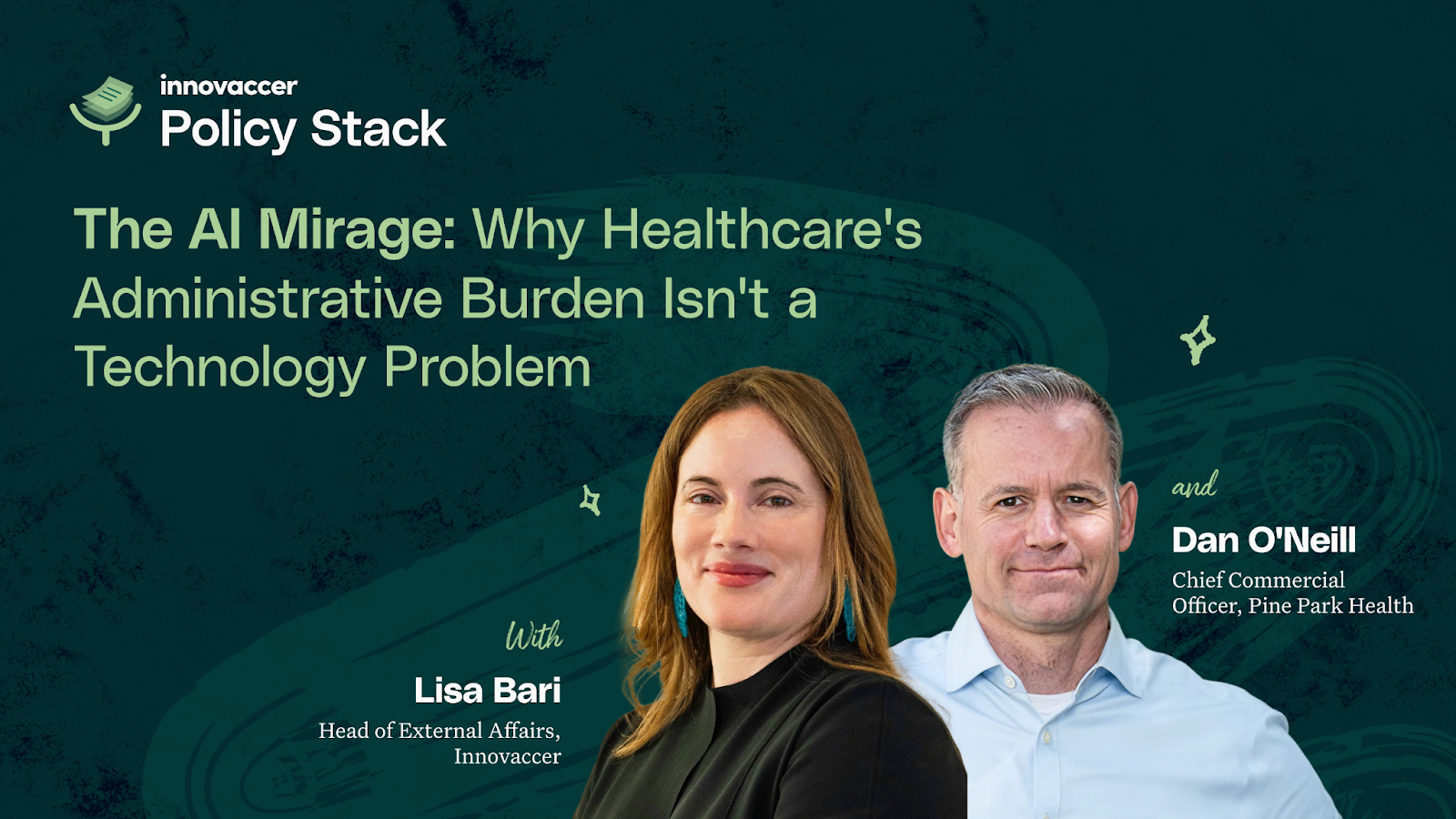
Dan O'Neill spent 15 years in health technology and services, and served as an RWJF Health Policy Fellow working on health policy in the U.S. Senate before joining Pine Park Health, where he sees firsthand how much of administrative complexity is actually optional. O'Neill argues that healthcare's administrative burden isn't a technology problem since most friction was readily addressable through 10-20 years old technology. The administrative problems persist because of business model problems, not computational ones. Here are key insights from Lisa Bari's conversation with Dan O'Neill on the Policy Stack Podcast:
1. Most Healthcare Problems Are Not Computational at Their Core
O'Neill discovered that while AI excels at computational tasks like ambient dictation and transcription, most healthcare work involves human interaction that isn't computational. Eliciting information from patients, understanding their social and economic circumstances, and figuring out what to do about a diagnosis in someone's specific life context: these are the hard parts of healthcare delivery. AI solutions often address only a narrow computational slice of much larger, more complex problems.
2. Administrative Friction Persists Despite Available Technology
The technology to solve most administrative problems existed years ago. Earlier in his career, O'Neill's EHR business development team built hundreds of interfaces with hospital labs and imaging centers. Today at Pine Park Health, he still encounters some fax-based ordering because their current EHR vendor hasn't invested in the same integrations. The problem isn't technological capability, it's business incentives and organizational inertia.
3. Value-Based Care Adds Complexity Instead of Reducing It
O'Neill was wrong in his earlier career assumption that value-based care (VBC) would be more efficient to operate. Most value-based arrangements layer additional requirements on top of fee-for-service models. Providers must do all the traditional documentation and billing work, plus quality reporting, risk adjustment coding, and navigate complex attribution mechanisms. The simplification promised under VBC never materialized in reality.
4. Payment Models Shape Everything in Healthcare
Effective healthcare policy cannot be designed without understanding how payment models shape what's possible and economically viable for healthcare organizations. Payment structures determine clinic locations, hospital sizes, organizational structures, and physician practice arrangements. O'Neill's framework: if you can't describe exactly which door someone walks through in plain English, your policy isn't ready for implementation.
5. Policy Solutions Should Eliminate Entire Functions, Not Optimize Them
Rather than trying to improve broken processes with AI, O'Neill advocates for eliminating duplicative administrative functions entirely. CMS could centralize provider enrollment instead of having every health plan replicate the same credentialing work slower. States could stop collecting "wedding signatures on paper forms" for processes that should be fully digital. Simplicity should be treated as a virtue even when you can't point to exactly why.
Want to hear how O'Neill navigates the intersection of health technology and policy? Discover why he thinks managed Medicaid should be eliminated entirely? Listen to the full Policy Stack Podcast episode here.

with the Power of Comet


.svg)
.svg)

.svg)