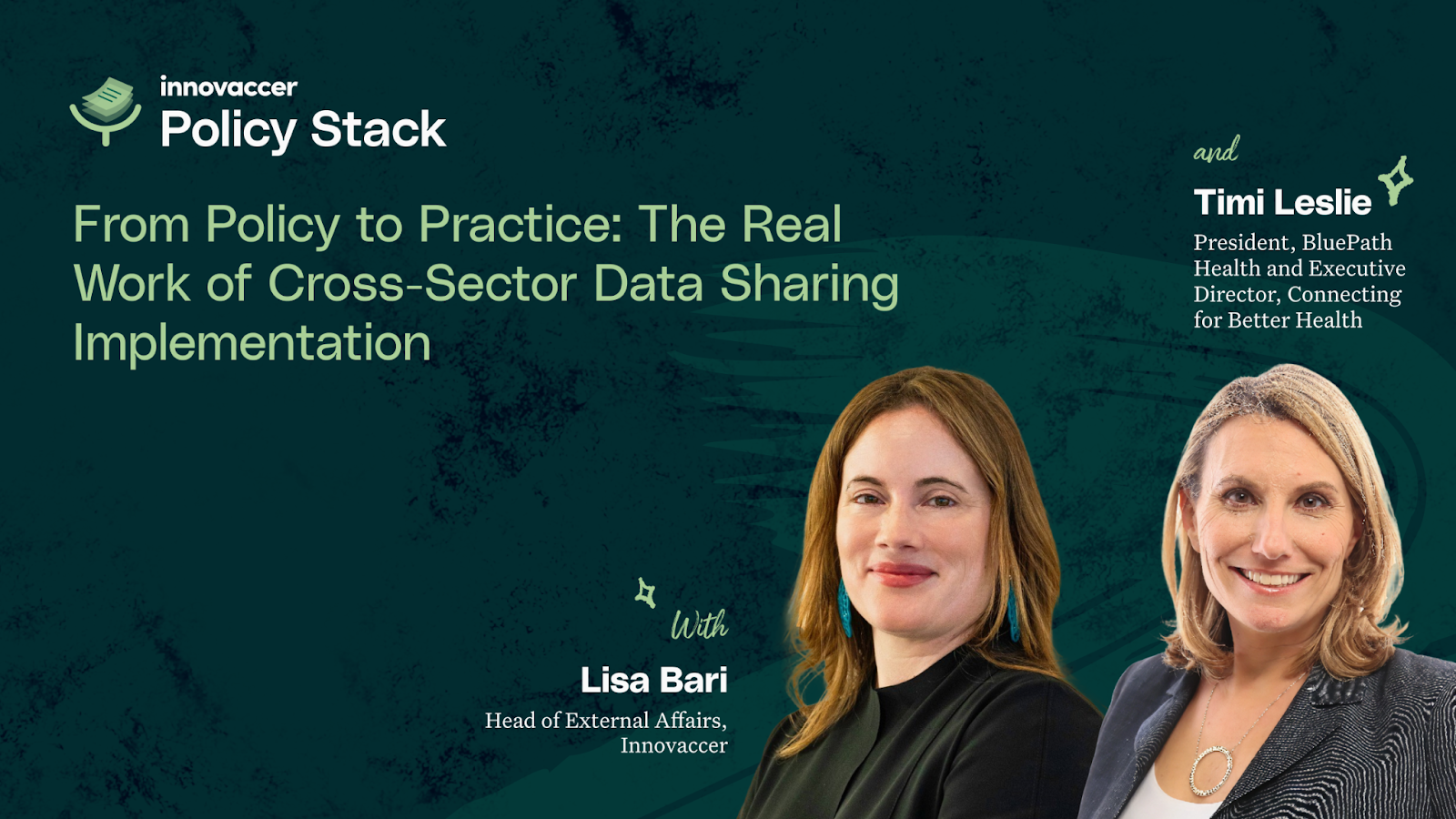
Timi Leslie has spent nearly 30 years implementing health IT policy, from helping hospitals digitize radiology departments in the 1990s to now leading California's ambitious cross-sector data exchange efforts. As President of Blue Path Health and Executive Director of Connecting for Better Health, Leslie sees firsthand why connecting healthcare with housing, social services, and community organizations is far messier than anyone anticipated. The challenge isn't technical capability, it's the fundamental complexity of making organizations that have never talked to each other suddenly share their most sensitive data. Here are key insights from Lisa Bari's conversation with Timi Leslie on the Policy Stack Podcast:
1. Technical Interoperability Is Just the Starting Line
Leslie reframes what meaningful data sharing actually means: it's not about replacing fax machines with APIs. Real interoperability means information is sent once, arrives in real-time, and contains everything needed for the specific use case without triggering cascades of follow-up phone calls and portal logins. Every certified EHR can technically share data, but that basic capability doesn't solve the coordination and organizational challenges that prevent actual care improvement. The gap between "can send data" and "enables better care" is where the real implementation work happens.
2. California's Cross-Sector Mandate Changes the Game
Unlike previous health IT initiatives focused on clinical systems talking to other clinical systems, California's Data Exchange Framework explicitly requires Social Services participation. This means organizations addressing housing, maternal health, and child welfare must now share data with healthcare providers. Leslie calls this approach uniquely bold: "It defines outright that this is about cross sector data sharing." The mandate serves as a forcing function to make progress that would otherwise remain stuck in pilot purgatory.
3. The Three-Legged Stool: Policy, Business, and Technology
Leslie founded Blue Path Health on the principle that successful implementation requires simultaneous expertise in policy, business operations, and technology. Understanding federal regulations, state-specific requirements, payer rules, and provider needs creates layers of complexity that demand this multidisciplinary approach. You cannot effectively implement health IT policy without understanding how regulatory frameworks mesh with real-world operations. Organizations attempting implementation with only one or two of these perspectives inevitably hit walls.
4. Housing Data Exchange Reveals the Messy Reality
When health plans and counties try to coordinate housing for shared clients, they immediately hit fundamental barriers. Homeless Information Systems (HMIS) are funded by a different federal department than CMS and capture completely different data. Health plans don't collect Social Security numbers; HMIS systems do. On the other hand, HMIS systems don't capture health plan IDs. People experiencing homelessness often lack permanent addresses for matching. Before anyone can share care plans or medication lists, they must solve the basic problem of identifying whether they're even talking about the same person.
5. County-Based Systems Compound the Challenge
California's county-level administration of Medicaid and social services creates dramatic resource disparities. Large counties like Alameda have extensive HMIS systems, housing agencies, and technical capacity. Small rural counties have far fewer resources and often lack the ability to answer basic questions about shared clients or available housing. Leslie challenges this fragmentation by asking questions like: "Why are we so connected to housing with these lines that we draw around a county? Why not think about it as a state or border states?" The artificial boundaries prevent seeing where beds and resources actually exist.
6. CalAIM Builds the Foundation for CBO Capacity
California's CalAIM initiative enables health plans to contract directly with community-based organizations (CBOs) for enhanced care management and community support services. This work is moving CBOs from Excel spreadsheets to HIPAA-compliant case management systems that can eventually connect with health information exchanges pulling clinical data. Leslie acknowledges the reality: "We are starting from scratch. But there's no better way than just to do the block and tackling to be able to help raise all boats." Infrastructure building is unglamorous but essential.
Want to hear Leslie's community of practice approach to solving cross-sector data sharing? Learn why she thinks housing availability shouldn't be constrained by county lines? Listen to the full Policy Stack Podcast episode here.